Build a Stronger Mind Than 99% of Men by Training Your Brain to Crave Challenge

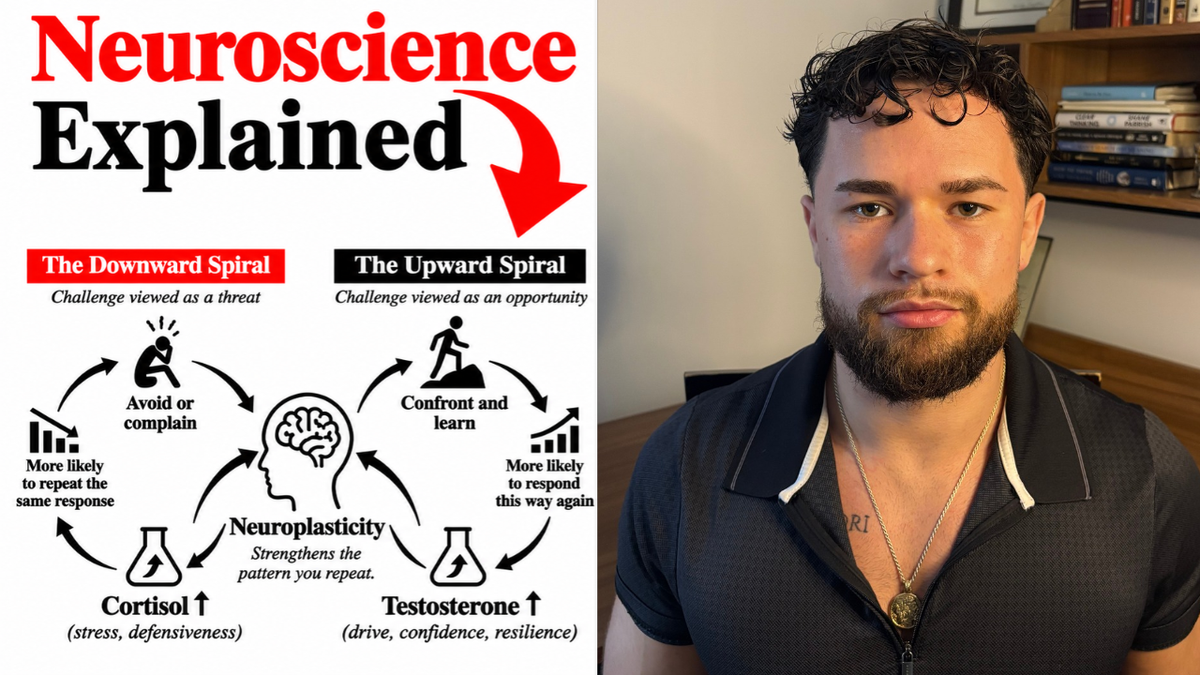
By Joshua Vecchio: Certified Personal Trainer, B.S. Biology & Exercise Science
On their deathbeds, most men will look back on mediocre lives they regret because they never did anything challenging.
The average man works a comfortable job that doesn't really fulfill him, but he stays because it “pays the bills” and he “gets treated well.”
He never asks for the pay raise or promotion he deserves because he doesn't want to “rock the boat.”
His wife wears the pants, and his kids walk all over him. Deep down, a small part of him resents them for it.
He justifies the dad bod by telling himself that he “doesn't want to look like a bodybuilder,” and falls off every fitness routine the moment he gets sore, or life gets busy, or he tweaks his shoulder.
Some men do take on challenges: starting a new role that demands more responsibility, starting your own side business, making a big move for a better opportunity, or getting married.
That's great! Finally, you've stepped out of your comfort zone and are making strides to level up your life.
But you complain incessantly about every challenge you run into.
The stress of handling a situation with a colleague leaves you ruminating for the entire week.
You lose sleep over the pressure of an impending deadline.
Juggling a job with your side gig tears you in two.
The hard conversation you need to have plays in your mind on repeat.
That doesn't make you “soft” or “weak" though.
It's not your fault that you shy away from challenges, or lament them when you're in them.
Humans are evolutionarily programmed to avoid discomfort and follow the path of least resistance (2). That's what kept our ancestors from wasting energy sprinting up mountains and needlessly battling one another.
On top of that, nobody ever taught you how to handle hardship effectively. Or introduced you to the notion that every hardship contains within it the raw material for your improvement.
But if you want to live a successful, fulfilling life, you will need to face challenges.
The problem is that most resilience advice is utterly useless.
On the one hand, you have guys like David Goggins commanding you to “stop being a little bitch.”
That might sound macho, but it's weak advice.
What're you supposed to do with that? What does “stop being a little bitch” actually look like in practice?
On the other hand, your therapist will tell you to “let things go,” and “live in the moment.”
Again, what're you supposed to do with that? How do you operationalize “letting things go?” Last time I checked, brains don't have fingers.
The central issue with both approaches is the same: if a piece of advice can't be translated into specific behaviors, it's just noise.
So this isn't going to be another lecture telling you to “toughen up buttercup.”
Or another back rub telling you that “your feelings are valid.”
Instead, I'm going to arm you with a mental model that will help you interpret challenges in a way that serves you, along with specific action steps you can take to apply it to your situation, today.
I promise that by the end of this article, you will look forward to the next challenge you face.
If you're struggling through something challenging, you don't have to face it alone. Book a call and I'll help apply these concepts to your situation.
What doesn't kill you makes you stronger, only IF...
You've probably heard the saying “what doesn't kill you only makes you stronger.”
The most important clause is completely missing from that statement.
What doesn't kill you only makes you stronger IF you consciously use challenges to grow stronger. You don't grow stronger by merely getting through them.
In fact, challenges can make you weaker if you let them break you by overreacting and complaining.
You grow stronger by deliberately exercising the character traits and skills needed to handle challenges effectively and stoically.
But this mental model isn't a simple binary where you either respond well to challenges, or not. It's a spectrum.
When you turn it vertically, it becomes a ladder. And the entire premise of this article is to help you ascend it.
The Evolution Ladder
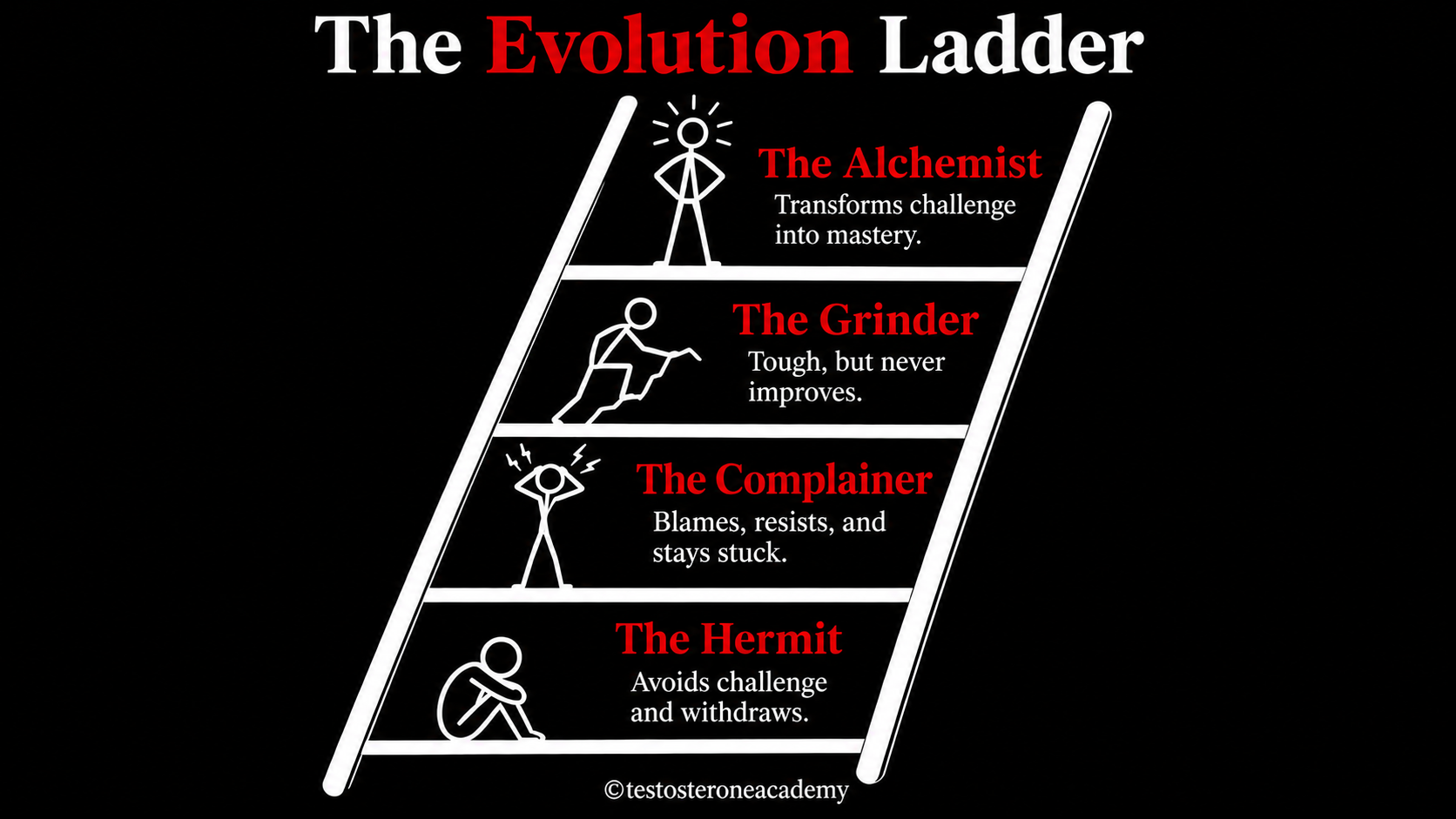
The first step is to identify which rung you're currently stuck on.
Before you do, I want to make something crystal clear: where you stand on this ladder is simply a reflection of how you've been conditioned to respond to challenges.
It says nothing about your standing as a human being.
You're not a bad person for being at level 0. You're not a weak man for being at level 1. You're not unintelligent for being at level 2.
So don't fuse your identity with how you've responded to challenges historically.
Separate your self-worth from your position on the ladder.
You're worthy of respect and love exactly as you are, and no matter what rung you're hung up on, you are fully capable of climbing higher with intentional training.
Level 0: The Hermit
You avoid challenges at all costs. You do the bare minimum to get by and spend the rest of your time on the sidelines. Your life is easy, but it's stagnant, unfulfilling, and does little to contribute to the advancement of humankind.
Level 1: The Complainer
You're in the arena. But you make life needlessly painful for yourself and those around you, and you make overcoming the challenges you face far more difficult by complaining your way through them.
Level 2: The Grinder
You're also in the arena. You're more resilient than the vast majority of men. You don't allow hardship to perturb you or how you show up for others.
But there are two missing pieces:
- You don't recognize challenges as opportunities for character development.
No doubt: you're tough. You can withstand the blows life delivers.
You think “this sucks, but I can get through it.”
But you never learn how to roll with the punches. You just grin and bear them.
- You don't go out of your way to intentionally seek out challenges that would strengthen your weaknesses or further your contribution to society.
The result? You stay the same.
Toughness is commendable. But adaptability leads to evolution.
Level 3: The Alchemist
Alchemy refers to the process of turning base metals into gold.
Mental alchemy involves reframing every perceived negative into a positive.
The alchemist doesn't stop at simply being unfazed by challenges. He's grateful for them because he knows that each provides him with an opportunity to edify his character.
He also doesn't stop at the challenges that happen to come his way.
He actively seeks out challenges that build up his lagging skills and traits, and that maximize his contribution to the world.
As a result, the alchemist is constantly improving, because he leans just beyond his comfort zone in all domains of life, and if fate doesn't deliver challenges by happenstance, he purposefully exposes himself to enough challenges to keep evolving.
If becoming the alchemist — this concept of embracing hardship, seeking out challenges, and constantly improving — sounds totally alien or out of reach for you, don't give up on yourself.
You, and every other man who reads this, are fully capable of evolving into the type of man who enjoys challenges.
So before showing you how to climb the ladder, I will prove that to you first.
Because if you don't believe that it's possible, all the practical advice in the world would go in one ear and out the other.
Believe first. Achieve second.
Remember, you don't have to go at this alone. If you'd like help finding your rung and mapping your climb, feel free to book a call.
All Life Forms Grow Through Resistance
“Just as nature takes every obstacle, every impediment, and works around it — turns it to its purposes, incorporates it into itself — so too a rational being can turn each setback into raw material and use it to achieve its goal.”
— Marcus Aurelius
This concept of “growing stronger” through hardship isn't just a consoling saying.
It's a fact of how the natural world works.
Tree roots don't stop growing when they run into rocks. They grow around them and use them to provide more stability than if the rocks weren't there.
Even though rocks don't provide nutrients and water like soil does, trees use their existence to their benefit.

Evolution by natural selection follows the same principle.
External factors called selective pressures challenge the survival of a species.
Examples include the elements, predators, competition between members of a species, etc.
Only the fittest members of a species survive such selective pressures and reproduce. Here are a few examples.
Imagine a famine wipes out 90% of a herd of camels, leaving behind only the 10% with a genetic mutation that gave them a hump of stored fat, enough to get them through it.
The survivors then reproduced and passed on those hump-generating genes to their offspring, improving their chances of surviving a famine.
That change — where the fittest members of a species pass on the traits that helped them survive to their offspring — is called adaptation, and it's what makes an entire species better equipped to survive the selective pressures of its environment in each subsequent generation.
The key point to note is it is the selective pressures themselves that drive evolution.
In this way, the very challenges that seem like impediments to a species' survival are actually what make it better adapted to its environment.
What doesn't kill an organism only makes it adapt.
What doesn't cause extinction of a species only makes it evolve.
This process doesn't just happen at the species level between generations.
It happens inside individual systems of your body within your lifetime.
When you get sick, your body mounts an immune response against the invading pathogen. After it's neutralized, your immune system "remembers” which antibodies were most effective at combating the pathogen, so it can deploy them with much more speed and efficacy the next time you're exposed to it.
Your mind works the same way. It can become more resilient through challenges. But only if you make the conscious intention to do so.
Evolution and immune responses are unconscious processes: they happen without you needing to think about them.
Choosing to perceive challenges as opportunities for character development, on the other hand, requires thought, because the human default is to avoid challenge and follow the path of least resistance.
While that tendency was useful for keeping our ancestors from overexerting themselves, it now causes us to skip the gym, avoid confrontation, mindlessly work easy jobs, and complain about every inconvenience.
If you wish to improve, you must consciously override that tendency by reframing challenges as opportunities for character development.
The part of your brain responsible for that is the prefrontal cortex, which handles planning, self-control, and deliberate, rational thought, and is the most recently evolved region of the human brain.
The Next Phase of Human Evolution
So the next stage of human evolution will still be survival of the fittest.
But unlike the camels, it won't be a matter of luck.
It'll be a matter of who makes the best use of their brains: the organ that enabled humans to become the most dominant species on the planet.
The fittest camels didn't choose to have humps. They were lucky enough to have genes that encoded for the growth of one, and it just so happened to help them survive famines. To the contrary, you get to choose how you respond to the “selective pressures” in your life.
For the first time in the history of life on Earth, the ability to decide whether or not you adapt and evolve is in your hands.
So before you read on, write down a challenge you’re facing, or one you know you’ve been avoiding. Hold onto it. We’ll come back to it.
First, an ancient Greek story shows exactly what's at stake.
The Choice of Hercules: Comfort or Greatness?

There's an ancient Greek parable called Hercules at the crossroads, where Hercules arrives at a fork in the road of his life.
Each direction is guarded by a goddess.
One goddess, named Kakia, promised Hercules a life of comfort and immediate gratification, free from hardship and struggle. But it would leave Hercules pacified, weak, and forgettable.
The other goddess, Arete, offered a path of toil, sacrifice, and perseverance. This path would be difficult and fraught with challenges. But it would lead to true glory, respect, lasting fulfillment, and it would bring out the best in Hercules.
Hercules decided to follow Arete’s path, which set the stage for his legendary life because in that moment, he committed to a life defined by effort, personal development, and purpose, giving rise to all of his victories that followed.
There are three relevant lessons from this parable...
Lesson #1: An easy life is a regrettable one
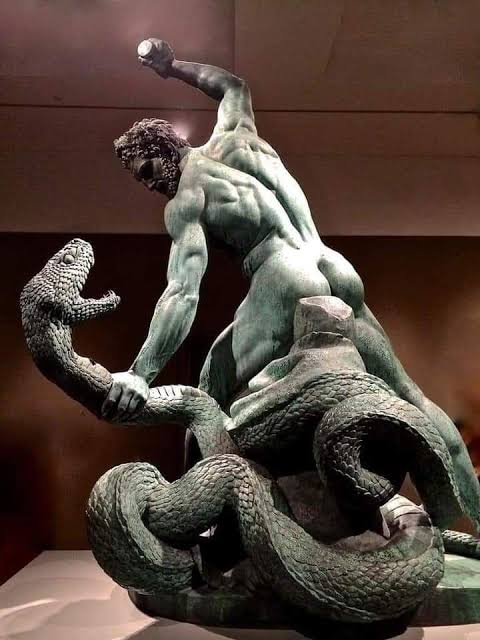
Hercules' labors were legendary because they were challenging.
Slaying a multi-headed hydra is legendary.
Lying around drinking wine? Not so much.
When you're on your deathbed, what kind of life do you want to look back on?
What stories do you want to have to tell your grandkids? What “dragons” will you have slain?
Will you be proud of the fact that you spent most of your life doing meaningless work just because it “pays the bills?”
Or would you die with more peace of mind knowing that the work you dedicated your life to made the world a better place and gave you a genuine sense of purpose and fulfillment, even if it was more challenging?
Think about the challenge you wrote down earlier. Will you let it become a story you tell your grandkids, or one you regret running from?
Lesson #2: You become the sum of your actions
Every challenge you face presents you with two choices:
- To view it as an opportunity for character development, exercise the virtues, skills, or character traits necessary to overcome it, and grow stronger as a result.
- To view the challenge as a condemnation, lament the situation, and actively make yourself weaker by training yourself to respond to challenges with despair.
Your identity is like a social media algorithm: you get more of what you click on.
Hercules became a legend because he chose the more challenging, yet more fulfilling path.
We all know people who “cry over spilled milk.” They're perturbed by the smallest inconveniences. Hitting a red light sets them off. They get stressed out from planning a Christmas party. You can't have an adult conversation with them because they get flustered and defensive from any amount of criticism, no matter how constructively you deliver it.
People often end up this way because they've faced too little challenge.
A multiyear study of more than 2,000 Americans found that people with a moderate history of adversity had better mental health and life satisfaction than people with no adversity at all, and they were less shaken by new hardships (4).
Philosopher Will Durant, paraphrasing Aristotle, put it this way: “we are what we repeatedly do. Excellence, then, is not an act, but a habit.”
Modern science backs up this ancient assertion.
Every time we repeat a thought pattern or action, we inscribe it further into our nervous system, making us more likely to behave that way again in the future, through a process called neuroplasticity — the brain's ability to change and adapt (5).
The conscious decision to view hardship as a means to grow stronger, or not, manifests biologically.
When a man interprets an event as a threat, levels of the stress hormone cortisol rise. But when a man perceives an event as a challenge, testosterone levels rise instead (6).
Testosterone is linked to the drive for status and competitiveness (8), a blunted fear responses (9), and low testosterone is associated with fatigue, low mood, and reduced motivation (10).
All of that affects how well a man can tackle hardship.
Testosterone shapes whether men perceive stressors as challenges or threats in the first place. Men with higher baseline testosterone show smaller stress responses, and higher testosterone is linked to lower perceived stress (6).
So if you have low testosterone (clinically called “hypogonadism” (10), you're fighting off the back foot before the challenge even starts.
And it's a growing problem: men today have lower testosterone than men the same age did a generation ago (12).
The relationship between neuroplasticity, testosterone, and cortisol creates a self-fulfilling feedback loop that can spiral up or down.
Every time you avoid challenge or view it as a threat and respond by complaining, you miss out on an opportunity to improve yourself, flood your bloodstream with cortisol, and entrench the neural connections in your brain that caused you to respond with an unhelpful outlook, all of which make you more likely to respond to the next challenge you face the same way, digging yourself a deeper hole.
But every time you confront a challenge and view it as a chance to improve yourself, you not only develop the virtues, skills, and traits needed to surmount it, you flood your bloodstream with testosterone, which gives you more gusto to take it on, and you also train your nervous system's generalized response to challenge to be one that perceives them as opportunities, making you more likely to respond with that mindset to the next challenge you face.
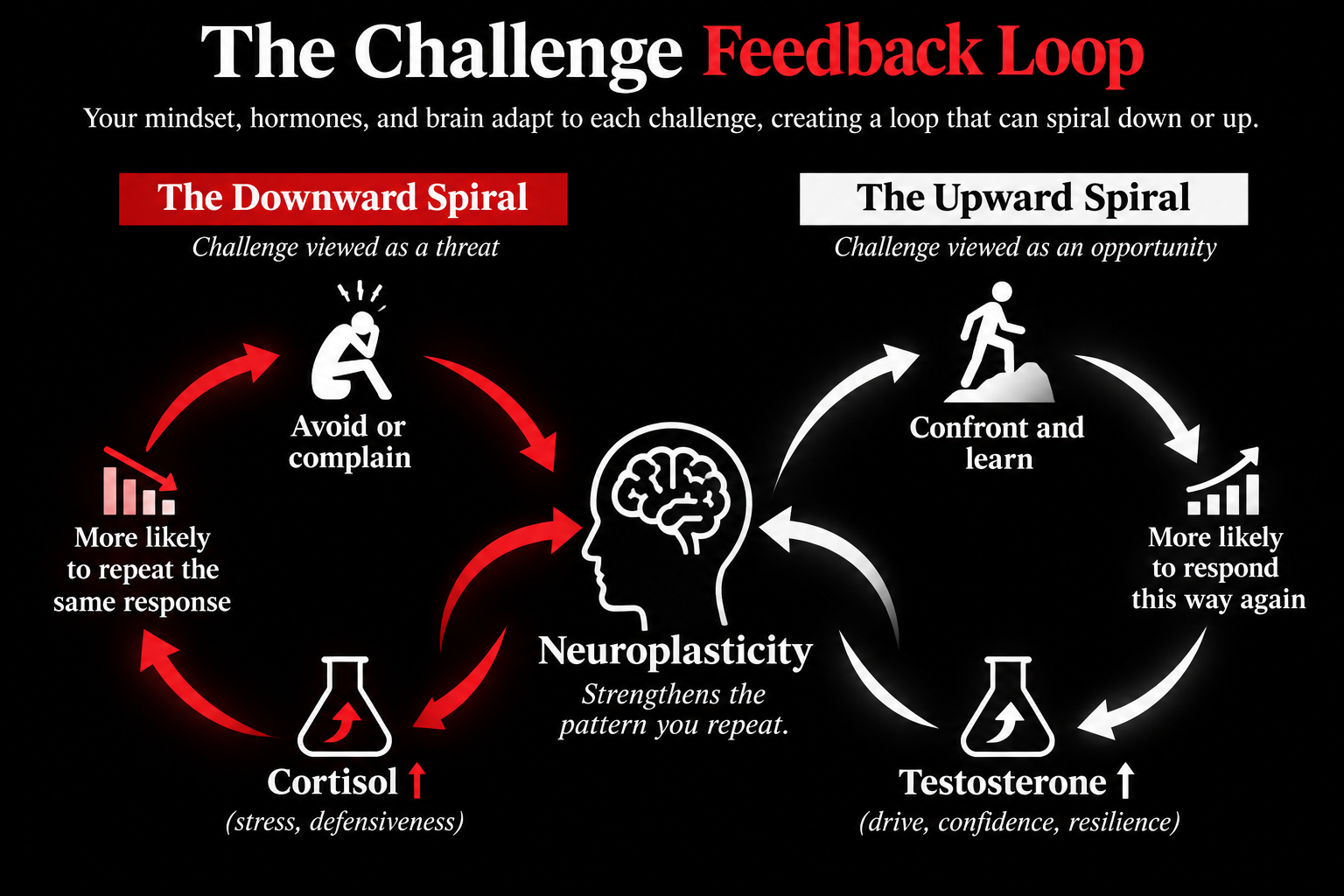
That's why what doesn't kill you will only make you stronger if you view it as an opportunity to do so.
If you don't, what doesn't kill you will only make you weaker.
If you've been stuck in the downward spiral and have noticed more irritability, mood swings, chronic fatigue, stubborn belly fat, or sexual issues, you might have low testosterone.
If you're struggling with any of those symptoms, feel free to book a call.
I'll review your current situation and map out a custom plan to help you feel like a man again.
Lesson #3: Your response can either make the situation worse, or better
Responding negatively to a challenge makes you needlessly miserable.
The challenge itself is difficult enough. Why add insult to injury by bemoaning it?
The “what doesn't kill you” mentality makes challenges more bearable.
In addition to making you unnecessarily miserable, complaining blinds you to solutions that would otherwise be obvious, disabling your ability to overcome the challenge at hand (13).
I once got an email from my manager informing me of upcoming pay cuts that were totally baseless and unjustified.
I was so enraged that I hurled a bottle of almond milk across the room.
In that moment, I was blind to the fact that my role wasn't a good opportunity anyway. After my reaction subsided, I realized that I could've made almost twice as much money if I doubled down on my own personal training business.
So I decided to step down, and the challenge took care of itself.
If I had remembered to adopt the “what doesn't kill you” outlook the moment that email hit my inbox, I might've spared myself, and that bottle of almond milk, needless self-inflicted pain, and I could've solved the problem immediately, instead of several days later.
Reining in your emotions is a challenge in and of itself. Using your prefrontal cortex to regulate the emotional centers of your brain requires cognitive effort (14).
The path of least resistance is letting your emotions run unchecked. The harder path is keeping them under control. That's why so many people fail to do it.
So what’s your bottle of almond milk? Think of the last time a weak reaction blinded you to a solution that seems obvious now, then ask what solution might be hiding within the challenge you wrote down.
How to Climb The Evolution Ladder
In today's world, we are insulated against challenge by default, so you need to go out of your way to expose yourself to them if you ever want to evolve.
But guard against the opposite extreme: taking on more challenge than you can handle, overwhelming yourself, concluding that it's too hard, and never trying again.
This isn't a hardness contest.
It's a stepwise approach to develop your character, skills, and resilience by leaning slightly beyond your comfort zone, adapting, recovering, and repeating.
And you can be on different levels of the ladder in different domains of your life.
You could be an alchemist in your career and a hermit in your love life.
You could be a grinder in the gym and a complainer in your career.
So start by identifying the domain where you need the most work, then do only the exercises to climb from your current rung to the next.
Whatever rung you’re on, run every challenge through this process:
- Name the “selective pressures” or “pathogens” in your life — the challenges you’re facing or avoiding.
- Identify the “adaptations” or “antibodies” — the skills or traits they demand.
- Write one line about how you will exercise them.
Here are three examples of this process in action:
Example 1
- Challenge: you want to go all-in on your own business, but you're afraid to leave your stable job.
- Trait(s) needed: foresight, planning, and courage.
- One line: “to overcome my fear of leaving my job, I will forecast my revenue for next quarter based on last quarter's revenue, and will write a contingency plan with the steps I will take to financially recover if my business fails.”
Example 2
- Challenge: you're stressed about the higher levels of responsibility your new role demands of you.
- Trait(s) needed: stress management techniques.
- One line: “to reduce the stress I'm feeling about my new role, instead of just complaining that my job is stressful, I will spend one hour this weekend researching stress management strategies, and will pick one to apply every day next week.”
Example 3
- Challenge: you want to make fitness a priority but fall off every time your week gets busy.
- Trait(s) needed: time management, discipline, consistency.
- One line: “to make training a consistent habit, I will design a training plan in advance, block off time to train in my calendar every Sunday, and I will do at least the first set even if I don't feel like training that day.”
Notice that all of these interventions require cognitive effort:
- Forecasting revenue and writing a contingency plan.
- Researching and applying stress management strategies.
- Designing a training plan and making time for training.
That's the point. Effort is what ingrains the traits.
It's the “bicep curl” that makes the muscle of your mind stronger.
Level 0 → 1: From Hermit to Complainer
Horizon: the life you'll look back on.
The deceptive part about being a hermit is that avoiding challenge doesn't cost you anything you can feel on any given day. The cost only shows up when you zoom out and look at your life as a whole.
These exercises give you a perspective most men never consider until it's too late.
Action Items
- Write out all past challenges you've been through as far back as you can remember, and reframe them in a positive light by describing how they developed skills or traits you currently possess.
- Staying with the metaphor of the fork in the road, stop where you are, turn around, and look back at how far you have come.
- Example: you picked a hard major in college, and had to sacrifice the “pleasures” of college life, but it paid off because it opened career doors that otherwise wouldn't be available to you.
- This helps you realize that, since the challenges you overcame in the past were what cultivated your strengths, the challenges you're facing now, or will soon face, will mold you into an even more capable version of yourself in the future. It makes the process of growing stronger through challenges seem more evident and possible for you personally.
- It also gives you confidence in your ability to overcome challenges because you've proven to yourself that you have endured challenges in the past, and can do so again in the present or future.
- Write out a few challenges you have historically avoided, and how failing to confront them is negatively affecting your life in the present.
- Example: you've been working the same rote job for the past decade because switching careers requires effort and risk, but you're miserable for forty hours a week and it's negatively affecting how you show up for your friends and family.
- This brings awareness to the damage following the path of least resistance has done to your life.
- Write out two versions of your future: one where you never confront the challenges you know you need to face, and another where you do. For each, write out a best and worst-case scenario. Examples:
Path 1 (least resistance): you never make fitness part of your life.
- Best case scenario: you're lucky enough to skirt serious chronic diseases and you're able to live with the body you see in the mirror on a daily basis without too much shame.
- Worst case scenario: you die early, spend your geriatric years decrepit, and in the meantime, are significantly impaired by lack of energy and confidence from hating the body you live in.
Path 2 (challenging): you make fitness part of your life.
- Worst case scenario: you have a few fewer hours per week to put towards other priorities and/or you don't make progress as fast as you'd like.
- Best case scenario: you come to love fitness, have no problem dedicating time to it, and see rapid, life-changing improvements in your physique, energy levels, and day-to-day functionality.
This thought exercise leverages a technique called prospective retrospection: mentally time-travelling into the future and looking back on the challenges you're facing now to give you a perspective that you otherwise might not consider, and to make you aware of the long-term consequences of continually choosing the path of least resistance.
- Pick one challenge you've been avoiding and take the first step to take it on this week.
- Save three listings for jobs that align with the contribution you actually want to make through your career.
- Go to the gym and buy the membership. Now you have skin in the game.
- Write the contingency plan for how you'll handle leaving your job to go all in on your side hustle.
Level 1 → 2: From Complainer to Grinder
Horizon: how your current challenge unfolds.
If you're a complainer, you're already in the arena, so the cost of your response shows up right away: in how much you suffer through the challenge in front of you, and in how well you handle it.
So these exercises zoom in on the challenge you're facing right now.
Action Items
Write two outcomes for the challenge you’re facing now:
- One where you overreact and complain.
- One where you respond by looking for silver linings and solutions.
Which response leads to a more favorable outcome?
Example: You’re at level 1 in the gym. You force yourself to go, but you dread it the entire time. Then you tweak your shoulder.
Outcome 1 (overreact and complain):
- You spend the drive to the gym telling yourself how much you hate this. Every set feels heavier because you’re bracing against it.
- When your shoulder flares up, you take it as proof that training “just isn’t for you.” One skipped week turns into a skipped month.
- Six months later, you’re back where you started. Next time you try to start a routine, you’ll have one more failed attempt as proof to talk yourself out of it.
Outcome 2 (silver linings and solutions):
- Before you walk in, don’t let yourself complain. Instead, remind yourself of all the ways in which physical training benefits your health and physique. Also remind yourself that every session you show up for when you don’t feel like it is a rep for your discipline, not just your muscles.
- When your shoulder flares up, you ask what's in your control: what you can train — lower body, core, pressing angles that don’t hurt, working on corrective exercises, etc.
- The silver lining: the tweak exposed a weakness (poor mobility, sloppy form, adding weight too fast) that would have caused a worse injury down the road. Six months later, you’re stronger, more consistent, and your shoulder is healthier than it was before.
Notice that your shoulder hurts in both outcomes. The challenge is identical. The only thing that changed was your response. And the response that led to the best outcome was also the one that caused you the least psychological suffering.
Level 2 → 3: From Grinder to Alchemist
Horizon: the man you’re becoming.
If you're a grinder, you already handle whatever life throws at you. Your cost is quieter: you stay the same. So these exercises zoom out to the man you'll become if you keep merely enduring challenges instead of using them to grow.
- Write two future versions of yourself, ten years from now:
- One who mindlessly grinds through every challenge and stays the same.
- One who uses every challenge to build a skill or trait.
For each, describe where he is in his career, what his body looks like, and how he shows up for his family.
Example: your workload doubled after a round of layoffs.
Version 1 (the grinder): you put your head down and push through. You don't complain, and you never miss a deadline. Ten years later, you're still the guy who can handle a brutal workload. Same role, same skills, same ceiling. Everyone respects how tough you are. Nobody promotes you for it.
Version 2 (the alchemist): you treat the extra load as a crash course. You learn to delegate, automate the repetitive work, and push back on low-value projects. Ten years later, you're leading the team, because you learned the exact skills that the extra workload demanded.
Notice that both versions worked equally hard. Only one of them grew.
- Build your antibody list.
Your immune system keeps a record of every pathogen it has beaten and the antibodies that beat it, so it can respond faster next time. Your antibody list does the same thing for your mind.
Make three columns:
- The pathogen (a hardship you've overcome)
- The antibody (the skill or trait it demanded).
- The strategy (what you actually did that worked).
Example:
- Pathogen: my manager announced unjustified pay cuts.
- Antibody: emotional regulation and resourcefulness.
- Strategy: waited until my anger subsided before responding, then listed every alternative income source I had. That's how I realized my own training business could pay me almost twice as much.
Add a pathogen, antibody, strategy entry to your growing list every time you get through something hard. The next time a similar challenge shows up, check your list before you react. You already have the antibody. You just need to deploy it.
- Pick one challenge in your weakest domain and take it on on purpose.
That's what separates a grinder from an alchemist: not just enduring the challenges that happen to come your way, but proactively using challenges to shore up your shortcomings.
Look at the major domains of your life (career, body, relationships, finances, and mind) and find the one where you're lowest on the ladder.
Then pick one challenge just beyond your comfort zone in that domain. Remember: this isn't a hardness contest. You're looking for the next rep, not the heaviest weight in the gym.
- Career: ask for the raise or promotion you know you deserve.
- Fitness: sign up for an event 12 weeks from now that you can't finish at your current fitness level.
- Relationships: have the conversation you've been replaying in your head for weeks.
Put a date on when you'll commit to the challenge this week. A challenge without a deadline is just a nice idea.
How to make it your default before the next challenge hits
Everything above is a model for dealing with the challenges life hands you.
Everything that follows is how to train for them in advance.
- Keep it top of mind
Remember Durant's summary of Aristotle: “We are what we repeatedly do.” And that through neuroplasticity, we can deliberately change the neural connections in our brains that influence how we think and behave.
The best way to make the "what doesn't kill you" mentality second nature is through sheer repetition of reminding yourself to apply it consistently.
Every day for the next month, repeat the following process:
- In the morning, take five minutes to call to mind or write down a challenge you are anticipating that day, and either visualize or describe the skills or traits you need to handle it well, and how applying them will improve your character.
- In the evening, recall one challenge or hardship that came up that day, however small, and reflect on if you responded as a hermit, complainer, grinder, or an alchemist, how your response influenced your character development, and how you could respond just a little bit better to the next challenge you face.
- Study the origins
I got it tattooed on my arm so I never forget it: Amor Fati, Latin for “Love Your Fate.”
Derived from a school of ancient philosophy called Stoicism, the logic behind amor fati is that we should love our fate, no matter what it may be, because every occurrence presents an opportunity to exercise virtue and develop our character.
It's a three-word distillation of the entire "what doesn't kill you" mindset, which originated in Stoicism. So if you want to deepen your understanding of this outlook, I highly recommend getting inside the minds of the thinkers who originally developed it by reading:
- Meditations, by Marcus Aurelius (the Gregory Hays translation).
- The Enchiridion, by Epictetus (the A. A. Long translation, titled “How To Be Free”).
The "what doesn't kill you" mentality recurs often in their writings, so one quote per day will contribute to the repeated exposure to this concept needed to keep it top of mind.
- Deploy it on purpose
The biological version of the “what doesn’t kill you” concept is a process called hormesis, whereby small doses of a stressor make a living system adapt to it, but a dose that exceeds its ability to process it and recover damages the organism.
- Just enough strength training causes your muscles to grow back bigger and stronger. Too much can cause exertional rhabdomyolysis (“rhabdo”) — a severe, potentially life-threatening condition caused by excessive overexertion.
- Just enough cold exposure activates brown fat, increasing your metabolism and helping you keep warm (16). Too much cold exposure, and you freeze to death.
- Fasting upregulates autophagy, your body's natural cellular “cleaning” process, and intermittent fasting has been shown to improve insulin sensitivity and metabolic health. In animal studies, it even extends lifespan (17). Go too long without food though, and you starve to death, or lose a lot of muscle mass.
The hormetic benefits are different, but the mental training ground is the same: you are purposefully exposing yourself to something challenging, and going into it with the intention to exercise the "what doesn't kill you" mentality.
So the entire time your muscles are burning, your heart is racing, or your body is shivering, continually remind yourself that what you're doing makes your body stronger through hormesis, and the act of doing something challenging itself inscribes the “what doesn't kill you” mentality into your mind, making it more likely to become your default response to spontaneous challenges that show up in your life outside of the gym or cold tub.
An added benefit: the hormones and neurotransmitters (namely, adrenaline and dopamine) released during hard training and cold exposure improve the formation of novel neural connections in the brain, which form the basis of new memories, behaviors, and thought patterns. This will engrave the "what doesn't kill you" mentality even more deeply into your nervous system.
That'll engrave the “what doesn't kill you” mentality even more deeply into your nervous system.
“As a blazing fire takes whatever you throw on it, and makes it light and flame.”
— Marcus Aurelius
Why You'll Look Forward to Your Next Challenge
If you've made it this far into this article, that's already proof that you're not weak, soft, lazy, or undisciplined.
In fact, it's a sign that you're already ahead of the pack. Most men in today's world don't have the attention span or bandwidth to read 5,000+ cognitively demanding words.
At the start of this article, I promised that you would look forward to the next challenge you face.
Here’s why you will.
The next time your boss drops an impossible deadline on your desk, or your shoulder flares up mid-set, or a hard conversation with your wife can’t wait any longer, you won’t just see a problem.
You’ll see a selective pressure.
You’ll know exactly which rung of the ladder you’re standing on, which trait the moment is asking you to deploy, and what one line you’re going to write that evening.
A man who knows every obstacle is raw material for his own evolution doesn’t dread obstacles. He seeks them out.
That said, wherever you currently stand on the ladder, it is your moral duty as a man to progressively climb to the top.
Because the choice of Hercules doesn’t end with the individual.
Men today face a selective pressure no previous generation has faced.
Testosterone levels have been falling roughly 1% per year (12).
Sperm counts have dropped by more than half between 1973 and 2011 (21).
Self-inflicted extinction would be a pretty disappointing fate for the most advanced life form that’s ever existed.
The path we take as a society starts with the day-to-day choices made by men like you.
But most men have been conditioned to respond like hermits.
Which is why on their deathbeds, most men will look back on mediocre lives they regret because they never did anything that demanded their best (1).
You don’t have to be one of them.
Picture your own deathbed, looking back on the dragons you slayed: the business you built, the body you earned, the hard conversations you didn’t run from, the man your kids watched you become.
None of those stories you tell your grandkids will be about the days that were easy.
And the world you leave your grandkids to live in won't be a pleasant one if we men don't get our act together.
Every man who chooses challenge casts a vote for a better world, and for a life worth looking back on.
Where will you cast your ballot?
Cast your first vote today by booking a call if you're ready to build a life you'll be proud of when you die.
I'll see you in the next one,
Josh
By Joshua Vecchio: Certified Personal Trainer, B.S. Biology & Exercise Science
References
- Gilovich, T., & Medvec, V. H. (1995). The experience of regret: What, when, and why. Psychological Review, 102(2), 379–395. https://doi.org/10.1037/0033-295X.102.2.379
- Kool, W., McGuire, J. T., Rosen, Z. B., & Botvinick, M. M. (2010). Decision making and the avoidance of cognitive demand. Journal of Experimental Psychology: General, 139(4), 665–682. https://doi.org/10.1037/a0020198
- Teffer, K., & Semendeferi, K. (2012). Human prefrontal cortex: Evolution, development, and pathology. Progress in Brain Research, 195, 191–218. https://doi.org/10.1016/B978-0-444-53860-4.00009-X
- Seery, M. D., Holman, E. A., & Silver, R. C. (2010). Whatever does not kill us: Cumulative lifetime adversity, vulnerability, and resilience. Journal of Personality and Social Psychology, 99(6), 1025–1041. https://doi.org/10.1037/a0021344
- Lally, P., van Jaarsveld, C. H. M., Potts, H. W. W., & Wardle, J. (2010). How are habits formed: Modelling habit formation in the real world. European Journal of Social Psychology, 40(6), 998–1009. https://doi.org/10.1002/ejsp.674
- Zueger, R., Annen, H., & Ehlert, U. (2023). Testosterone and cortisol responses to acute and prolonged stress during officer training school. Stress, 26(1), Article 2199886. https://doi.org/10.1080/10253890.2023.2199886
- Dickerson, S. S., & Kemeny, M. E. (2004). Acute stressors and cortisol responses: A theoretical integration and synthesis of laboratory research. Psychological Bulletin, 130(3), 355–391. https://doi.org/10.1037/0033-2909.130.3.355
- Eisenegger, C., Haushofer, J., & Fehr, E. (2011). The role of testosterone in social interaction. Trends in Cognitive Sciences, 15(6), 263–271. https://doi.org/10.1016/j.tics.2011.04.008
- Hermans, E. J., Putman, P., Baas, J. M., Koppeschaar, H. P., & van Honk, J. (2006). A single administration of testosterone reduces fear-potentiated startle in humans. Biological Psychiatry, 59(9), 872–874. https://doi.org/10.1016/j.biopsych.2005.11.015
- Bhasin, S., Brito, J. P., Cunningham, G. R., Hayes, F. J., Hodis, H. N., Matsumoto, A. M., Snyder, P. J., Swerdloff, R. S., Wu, F. C., & Yialamas, M. A. (2018). Testosterone therapy in men with hypogonadism: An Endocrine Society clinical practice guideline. The Journal of Clinical Endocrinology & Metabolism, 103(5), 1715–1744. https://doi.org/10.1210/jc.2018-00229
- Ilkevič, E., Jašinskaitė, E., Gaižauskaitė, R., & Grikšienė, R. (2025). Testosterone and cortisol moderate perception of mild psychosocial stress in young males. Psychoneuroendocrinology, Article 107557. https://doi.org/10.1016/j.psyneuen.2025.107557
- Travison, T. G., Araujo, A. B., O'Donnell, A. B., Kupelian, V., & McKinlay, J. B. (2007). A population-level decline in serum testosterone levels in American men. The Journal of Clinical Endocrinology & Metabolism, 92(1), 196–202. https://doi.org/10.1210/jc.2006-1375
- Fredrickson, B. L. (2001). The role of positive emotions in positive psychology: The broaden-and-build theory of positive emotions. American Psychologist, 56(3), 218–226. https://doi.org/10.1037/0003-066X.56.3.218
- Ochsner, K. N., & Gross, J. J. (2005). The cognitive control of emotion. Trends in Cognitive Sciences, 9(5), 242–249. https://doi.org/10.1016/j.tics.2005.03.010
- Schoenfeld, B. J. (2010). The mechanisms of muscle hypertrophy and their application to resistance training. Journal of Strength and Conditioning Research, 24(10), 2857–2872. https://doi.org/10.1519/JSC.0b013e3181e840f3
- van der Lans, A. A. J. J., Hoeks, J., Brans, B., Vijgen, G. H. E. J., Visser, M. G. W., Vosselman, M. J., Hansen, J., Jörgensen, J. A., Wu, J., Mottaghy, F. M., Schrauwen, P., & van Marken Lichtenbelt, W. D. (2013). Cold acclimation recruits human brown fat and increases nonshivering thermogenesis. The Journal of Clinical Investigation, 123(8), 3395–3403. https://doi.org/10.1172/JCI68993
- de Cabo, R., & Mattson, M. P. (2019). Effects of intermittent fasting on health, aging, and disease. The New England Journal of Medicine, 381(26), 2541–2551. https://doi.org/10.1056/NEJMra1905136
- Šrámek, P., Šimečková, M., Janský, L., Šavlíková, J., & Vybíral, S. (2000). Human physiological responses to immersion into water of different temperatures. European Journal of Applied Physiology, 81(5), 436–442. https://doi.org/10.1007/s004210050065
- Szuhany, K. L., Bugatti, M., & Otto, M. W. (2015). A meta-analytic review of the effects of exercise on brain-derived neurotrophic factor. Journal of Psychiatric Research, 60, 56–64. https://doi.org/10.1016/j.jpsychires.2014.10.003
- Santi, D., Spaggiari, G., Furini, C., Griseta, V., Zizzi, E. A., Granata, A. R. M., & Simoni, M. (2025). Temporal trends in serum testosterone and luteinizing hormone levels indicate an ongoing resetting of hypothalamic-pituitary-gonadal function in healthy men: A systematic review. Journal of Endocrinological Investigation, 48(11), 2721–2734. https://doi.org/10.1007/s40618-025-02671-9
- Levine, H., Jørgensen, N., Martino-Andrade, A., Mendiola, J., Weksler-Derri, D., Mindlis, I., Pinotti, R., & Swan, S. H. (2017). Temporal trends in sperm count: A systematic review and meta-regression analysis. Human Reproduction Update, 23(6), 646–659. https://doi.org/10.1093/humupd/dmx022