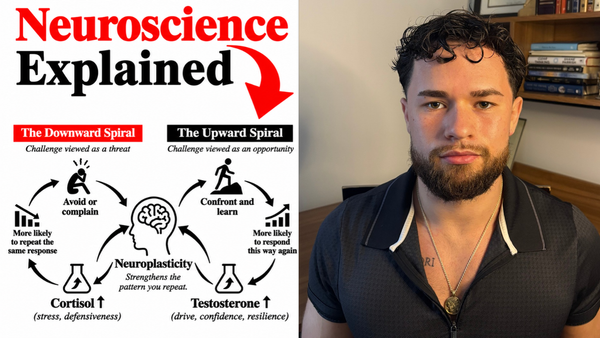
If You Want to Be Successful, Stop Beating Yourself Up (Do This Instead)
The self-hatred you mistake for high standards is keeping you from reaching the next level.


By Joshua Vecchio: Certified Personal Trainer, B.S. Biology & Exercise Science, MBA
If you're doing anything worthwhile with your life, you will “fail” at some point. And when you do, you are more likely to do more damage than the failure itself.
“Failing” isn't the enemy. It's proof that you're actually trying.
The enemy is viciously beating yourself up when you do.
Driven, type-A men are particularly susceptible to this blunder.
Not because they're stupid. Because they care a lot about whatever they “failed” at. If that sounds familiar, the good news is you're already ahead of the vast majority of men in 2026.
The bad news is that the self-hatred you mistake for high standards is what's keeping you from reaching the next level.
If you're a driven, type-A man, you'll want to bookmark this article, take notes, and set aside time to think about it, because in all of my experience working with (and living as) that demographic, I've found that the most likely cause of failure over the long term won't be the setbacks you face.
It'll be the wounds you inflict on yourself from how you respond to them.
So in this article, I'm going to explain why you beat yourself up, and how to stop for good.
If at any point you'd like my help overcoming self-sabotage so you can break through to the next level, feel free to book a call.
The Driven Man's Achilles Heel
“Never regard something as good if it causes you to lose your sense of shame.”
— Marcus Aurelius
The average man rarely fails because he doesn't even try hard enough to get to the point where failure is a possibility.
Having an aversive reaction to failure shows that you genuinely care about what you “failed” at. That's why you beat yourself up. (There is another, deeper reason why you beat yourself up that we'll tackle later).
The fact that you're in the arena, trying hard enough to fail, and don't like failing, already puts you ahead of the pack.
But it could be the very thing keeping you from reaching the next level.
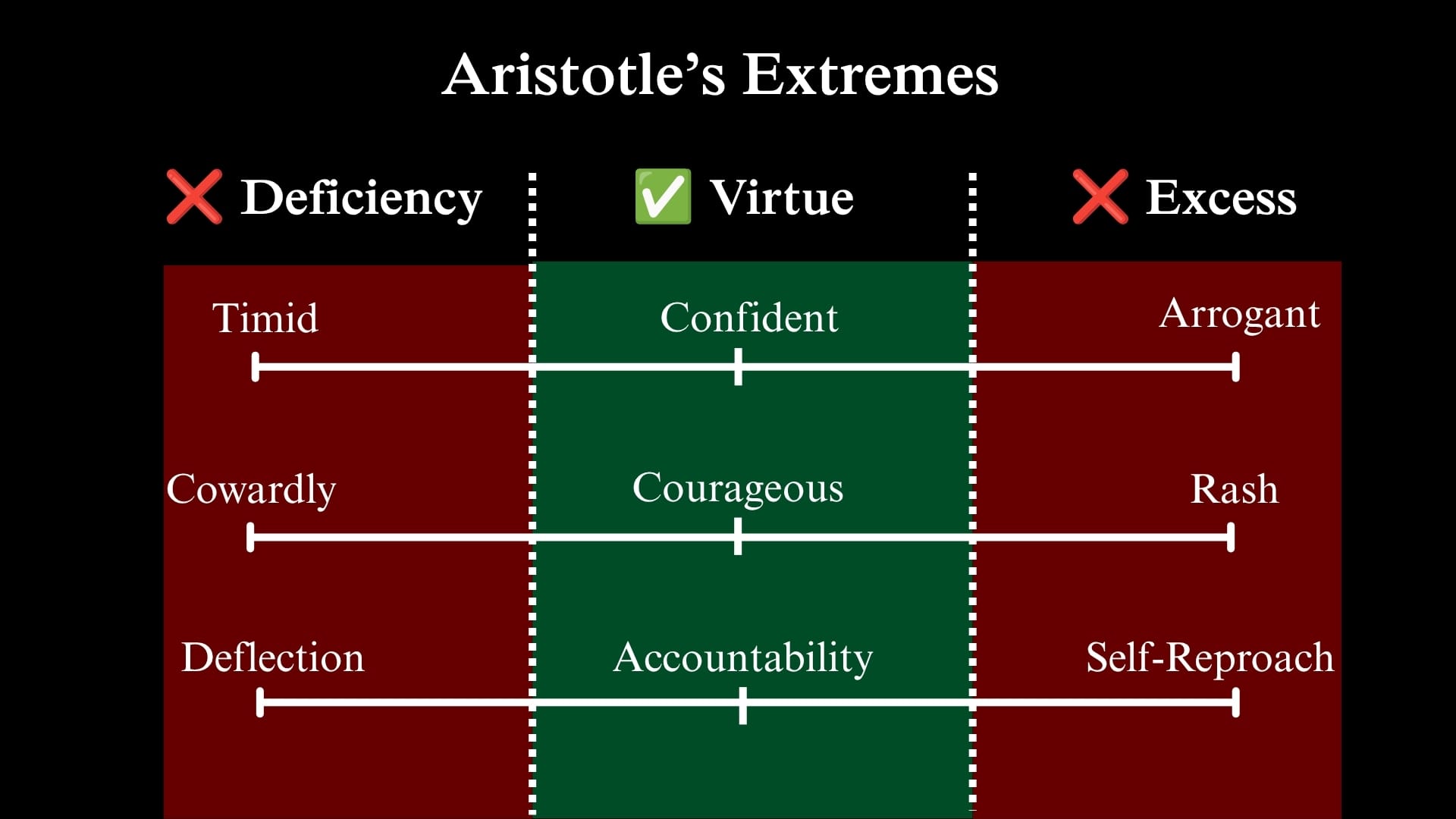
In the Nicomachean Ethics, Aristotle asserts that all character traits lie on a spectrum of two extremes, hyperbolē (excess) and elleipsis (deficiency), which are equally destructive in polar opposite ways.
For that reason, we should strive to strike the mean between them, which he called virtue.
- You don't want to be timid, or arrogant. You want to be confident.
- You don't want to be cowardly, or rash. You want to be courageous.
This balancing act is a virtue in and of itself: moderation.
When it comes to how you respond to failure, the deficiency extreme is deflection, and the excess extreme is self-reproach.
Let's unpack those now.
The Deflection Deficiency
Average men blame their failures on factors they can't control to absolve themselves of responsibility.
- “Sales are down because the economy is bad.”
- “I can't lose weight because of my age.”
The deceptive part is there usually is some truth to such excuses.
The economy can affect sales, and losing weight does get a bit harder with age.
Key word: some truth. External factors can influence your results, but they usually don't determine them entirely. In most cases, your actions, or lack thereof, have more of an effect on your outcomes than factors outside of your control.
In most cases.
But the other end of the spectrum is just as damaging, and it's the one a man like you is more likely to fall victim to...
The Self-Reproach Excess
Self-reproach (aka self-flagellation, self-blame, or “beating yourself up”) is when you harshly criticize yourself for failures disproportionate to your contribution to them.
- “Sales are down because I suck at sales.”
- “I can't lose weight because I'm undisciplined.”
You can tell which extreme you fall on by investigating the explanation for your failure that comes after the word because.
If your “because” is entirely things you can't control, you're a deflector.
If your “because” is your personal identity, you're a self-flagellator.
The subconscious “logic” behind beating yourself up goes something like this: “If I inflict enough mental pain on myself for failing, I'll work harder to escape my own whip, which will force me to succeed.”
Like shooting yourself in the foot to make yourself run faster, beating yourself up as a motivational strategy always backfires in the long run. Here's why.
Why Beating Yourself Up Backfires
Case Study #1: Cenai's Fat Loss
One of my fitness coaching clients could not lose weight for the life of him, and he was convinced that it was because he “wasn't disciplined enough.”
But the evidence that he lacked discipline was lacking.
He was a former college football player, graduated with academic honors, and held down a respectable job while building a podcasting business on the side.
After one look at his situation, it became clear that his inability to keep the weight off had nothing to do with a lack of discipline.
The real reasons were:
- He was in too much of a calorie deficit. A 6'2'' 220‑pound man should not be eating only 1,100 calories. Extreme calorie deficits decrease testosterone, causing your body to break down muscle while holding onto fat as a survival mechanism.
- He wasn't eating enough protein, causing him to lose muscle, which made fat loss harder because muscle burns calories at rest.
- He was on the keto diet, which is not optimal for training performance, muscle growth, or hormone health.
- He was overindexing cardio over strength training.
If anything, he needed “less” discipline. I had him increase calories and carbs, and channel his discipline into hitting the weights. Six months later, his physique was unrecognizable. All from a few subtle tweaks to his weight loss strategy.

Case Study #2: Luis' Muscle Growth
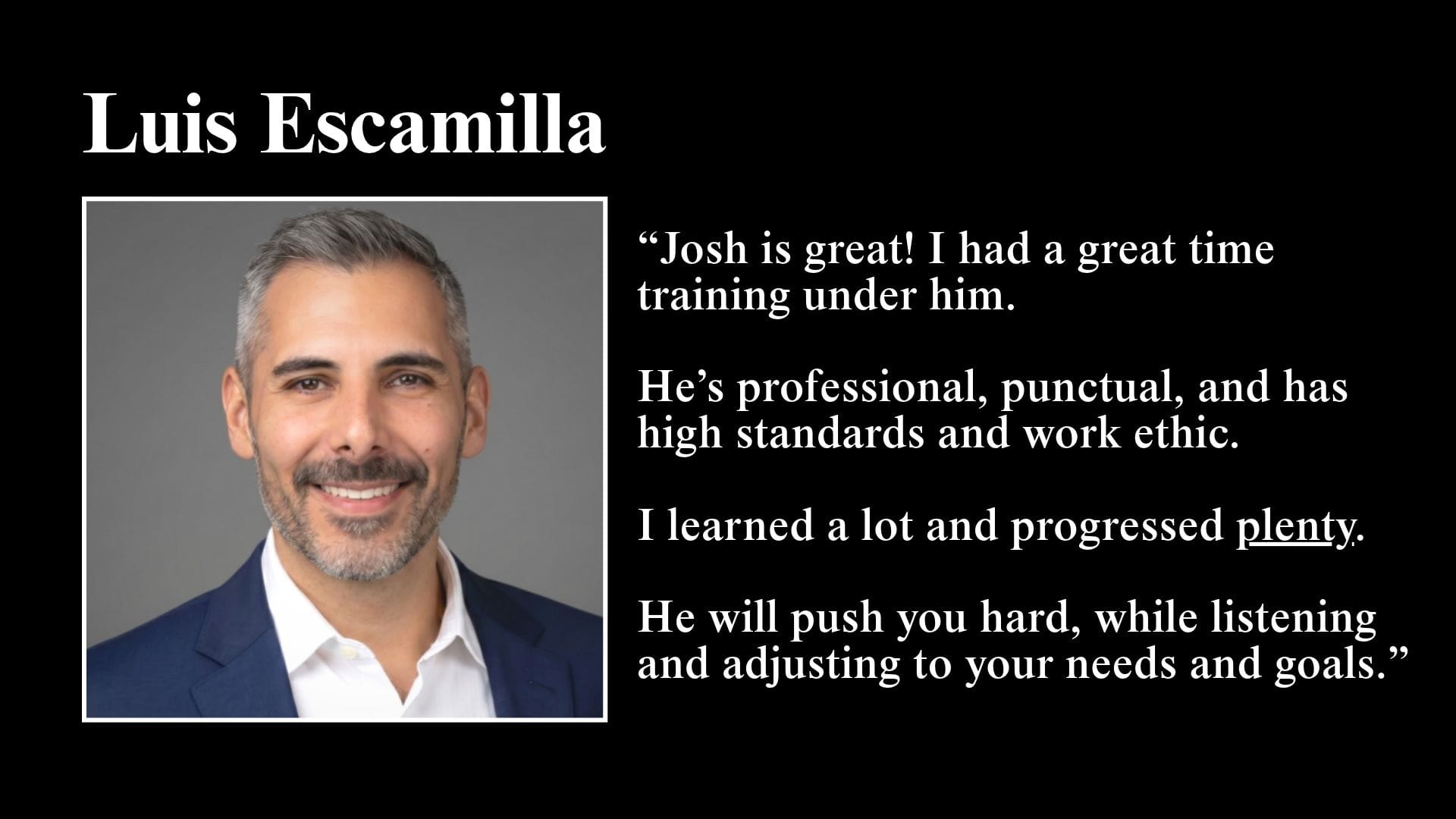
One of my personal training clients was convinced he couldn't build muscle because he “wasn't working hard enough.”
He'd been doing crossfit four times per week for over a year and could not put mass on his frame. His coach told him that he just needed to “work harder.”
Hearing that made my blood boil because he was already a paragon of hard work in all aspects of his life. He was consistent with his workouts, strict with his diet, more than capable of training hard, a renowned professor of high-level business courses, and author of several books.
There was no evidence that he lacked work ethic, and his coach telling him that he did caused him to blame himself for a problem that wasn't actually his fault.
The real problem was that crossfit is not optimized for muscle growth.
He could've done burpees and kettlebell swings until he was blue in the face (which he did), without ever noticing any difference in the mirror, because those movements don't drive muscle growth.
After training with me for 10 weeks on a bodybuilding-style lifting program, he added a noticeable amount of lean mass on his frame and was very happy with the progress he made.
He didn't need to work harder. He needed to channel his work ethic into a training modality that could create the results he wanted.
If you'd like my help achieving results like Luis or Cenai, whether it is in fitness, your career, or any other domain, book a call and let's see if working together makes sense.
Case Study #3: My Newsletter
A few months after starting this newsletter, my open rate was extremely low: 0.1%.
I just thought my newsletters weren't interesting. But even after months of consistent publishing, the open rate wouldn't budge.
When I brought it up with my mentor, he suspected that there must have been a technical issue.
Turned out I never activated my domain, so all of my newsletters were landing in spam. A major bottleneck in my business dissolved with the click of a button.
It wasn't a discipline problem: I was publishing consistently.
Or a skill problem: my newsletters were quality.
If I continued blaming myself, I might not have caught that simple issue until months or even years later.
Beating Yourself Up Blinds You to Problems & Solutions
Notice that in all of the cases above, self-reproach made the real problems impossible to see:
- My fitness coaching client who called himself undisciplined didn't see that his weight loss strategy was the reason he couldn't keep weight off.
- My personal training client who thought he wasn't working hard enough was blind to the fact that his training modality was the reason he couldn't build muscle.
- Assuming my newsletters weren't interesting kept the possibility of a technical issue off my radar.
If you aren't getting the results you want out, stop beating yourself up about it. Redirect that energy to figuring out why you're not making progress so you can develop a better approach.
Beating Yourself Up Makes You Needlessly Miserable
Beating yourself up puts you in a negative mental state that repels results.
If you call yourself a fatass every time you walk into the gym, you won't lift with the passion or intensity needed to sculpt your dream physique.
If you tell yourself you're a terrible leader because one project didn't go well, you won't lead the next one with conviction, and that one won't go well either.
If I show up to work in a foul mood because I spent all of Sunday ripping myself a new one for not making enough revenue, my grumpy demeanor will scare away all potential clients.
If I write my newsletters in a negative mindframe because I've told myself that nobody will find them interesting, I won't write them in an inspiring tone, which will reduce readership.
This “negative mental state” isn't “woo.” There's a real biological mechanism at work here. It's called the winner effect.
When you perceive yourself as a winner, testosterone rises. Testosterone improves mood, motivation, energy levels, and the drive for status, all of which improve your chances of success.
But when you beat yourself up, the opposite happens: you perceive yourself as a loser, testosterone goes down, and your mood, motivation, energy, and drive drop with it, making it much harder to achieve your goals.
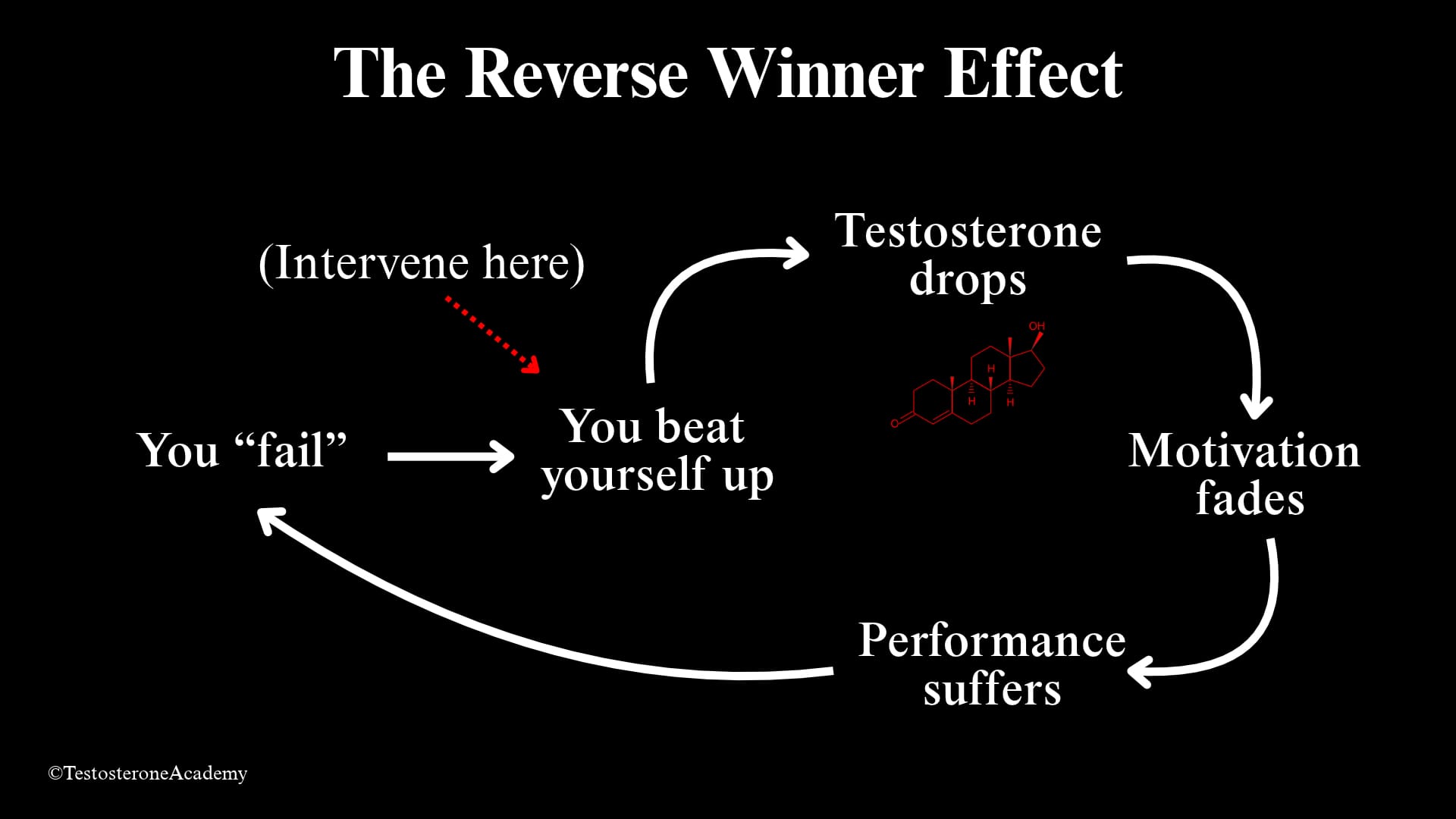
That's the hidden cost of self-flagellation that quietly holds driven men back.
The solution is to perceive everything, including failure, as a win.
You do that by recognizing that failure is evidence you're trying hard to succeed at something meaningful.
That takes effort off the table as the problem, and narrows the cause of your failure down to strategy or skill. And that failure is still a win, because it exposed a flaw you'd otherwise never have seen. More on that later. But first...
The Deepest Reason You Beat Yourself Up
Earlier we established that you beat yourself up because you care a lot about what you failed at. But here's a deeper factor at play.
Driven men are more prone to self-reproach because throughout history, a man's value was measured by his effectiveness at producing results (successful hunts, producing offspring, etc), so you are hardwired to attach your self-worth to your performance.
And that's a good thing, to an extent. If men felt no pressure to perform, there would be no progress. You absolutely should attack your goals, have high standards, and hold yourself to them.
But when you fuse your self-worth entirely to outcomes, you to consider yourself worthy of self-respect only when you "succeed” (gained the muscle, lost the fat, made the money, etc).
Every external failure then becomes a personal failing, so you attack the thing you think is responsible: you. And you attack it viciously, because you care a lot about succeeding.
But every time you tell yourself that you suck at sales, are undisciplined, or don't work hard enough, you turn a skill issue into a character flaw.
- Struggling to lose weight doesn't mean that you are an undisciplined person.
- Failing to build muscle doesn't mean you aren't a hard-working person.
- Missing your income target doesn't mean you're less of a man.
It just means that you currently lack the knowledge or skill to create the outcome you want. That's it. Nothing personal.
Labelling yourself as “undisciplined,” “stupid,” or “bad at sales,” programs your subconscious mind to believe those statements, which are aimed at the wrong target. They target you, when the real cause of your failure is your skill (which can be fixed).
So you live up to the label, because you've conditioned your mind to believe it's who you are, which creates a negative self-fulfilling prophecy. For example:
You tell yourself you're a bad salesman → you believe you're bad at sales → you self-sabotage every sales conversation → which reinforces the belief.
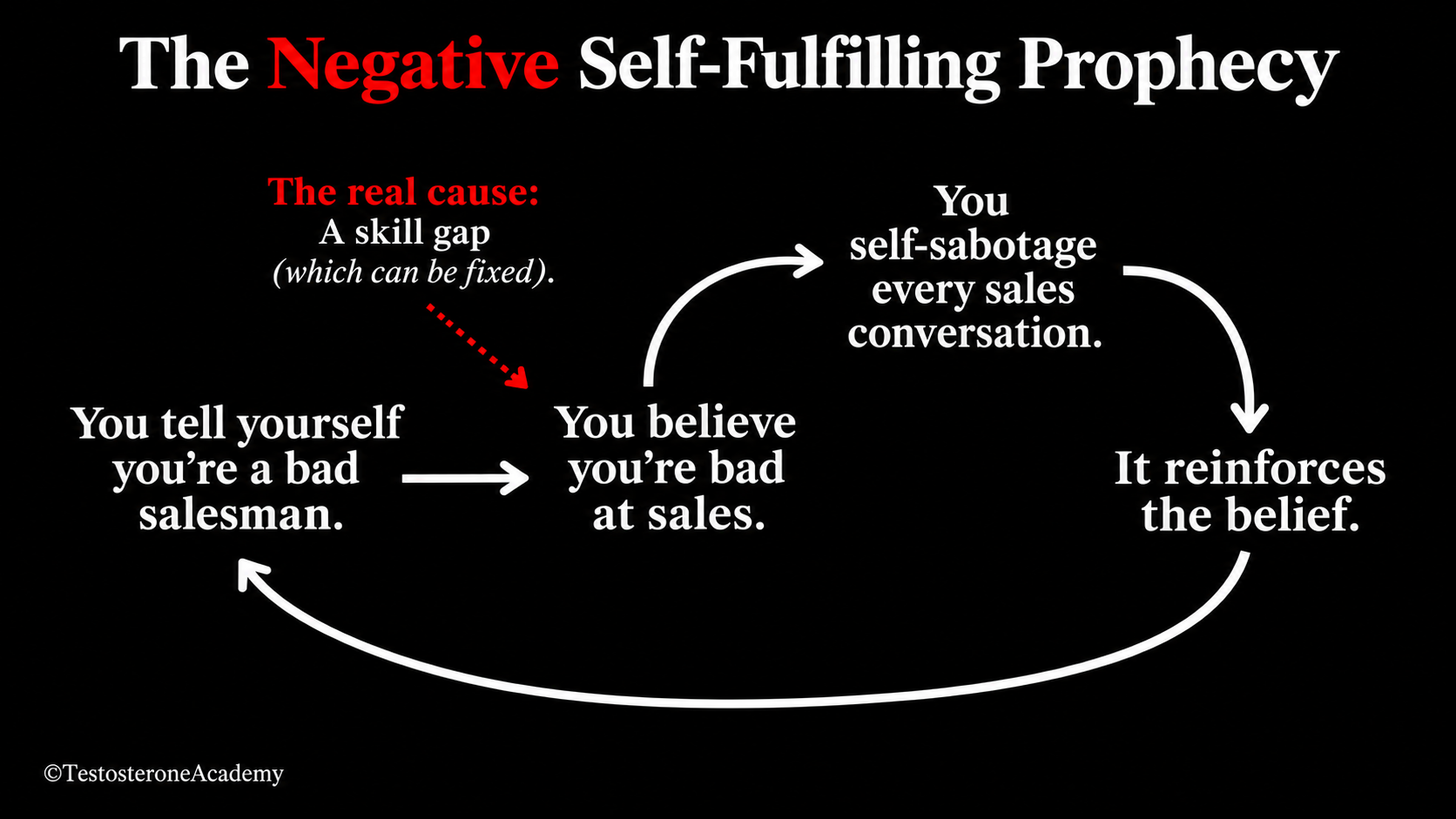
Looks eerily similar to the reverse winner effect, doesn't it?
Even when things are going well, riveting your self-worth to results leaves you in a precarious position. Your ego laps it up, you get a big head, and you're prone to an arrogant mistake.
When things inevitably go south, you're knocked off your high horse and tear down your own self-esteem.
In this way, your progress becomes volatile, and compounding progress never gets made.
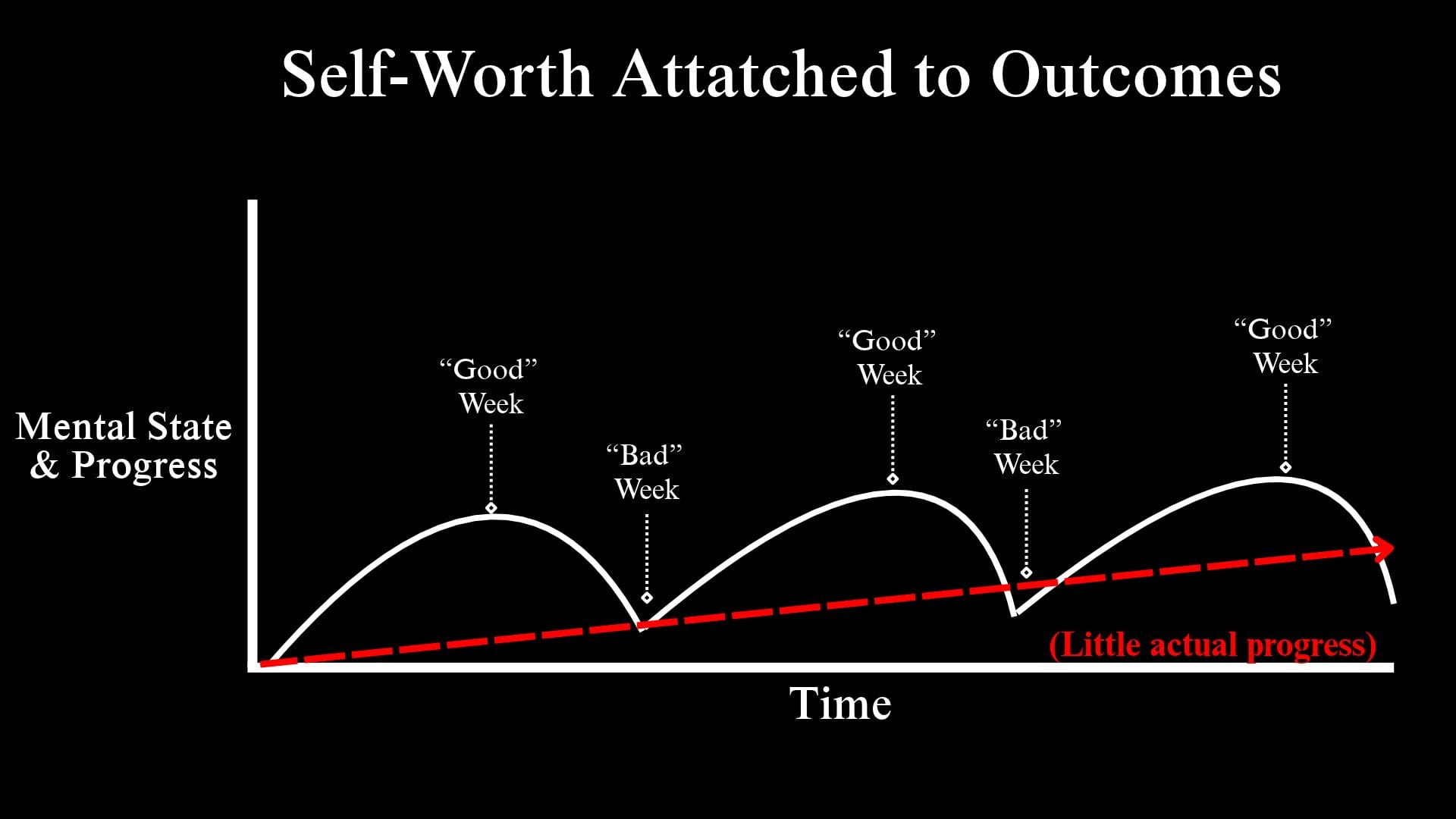
That's why the driven man's Achilles heel isn't his work ethic, intelligence, or standards. It's measuring his self-worth against outputs instead of inputs.
Which brings us to the fix.
The Alternative to Beating Yourself Up
“Receive without pride, let go without attachment.”
— Marcus Aurelius
In every domain of life, there are two kinds of numbers.
- Leading indicators (inputs): articles written, prospects contacted, workouts completed, calories eaten. These are always in your control.
- Lagging indicators (outputs): revenue, weight on the scale, open rates, promotions. These are influenced by your inputs but also subject to forces outside your control (the market, the algorithm, the economy, the decisions of other people, etc).
Here's the distinction that resolves everything, and I want you to read it twice because the rest of this hinges on it:
You should never tether your self-worth to inputs because you can only ever influence them. Your inputs and your character are the only things that are ever in your control, and thus are the only things you can safely build an identity on.
Both of those sentences are the same idea pointed in two directions:
- A failure isn't a verdict on your manhood, because the outcome wasn't fully yours to decide.
- But your contribution to a failure, and, even more importantly, how you respond to a failure (your character), is yours, completely.
I'll say it one more time: you should only grade your self-worth on inputs, and your character, not the outcomes downstream of them.
Keep your high standards, but aim at the part of the story that only you can write.
To put that into practice, your first move is to exercise what the Stoics called the dichotomy of control: identify which inputs are actually within your control in your situation.
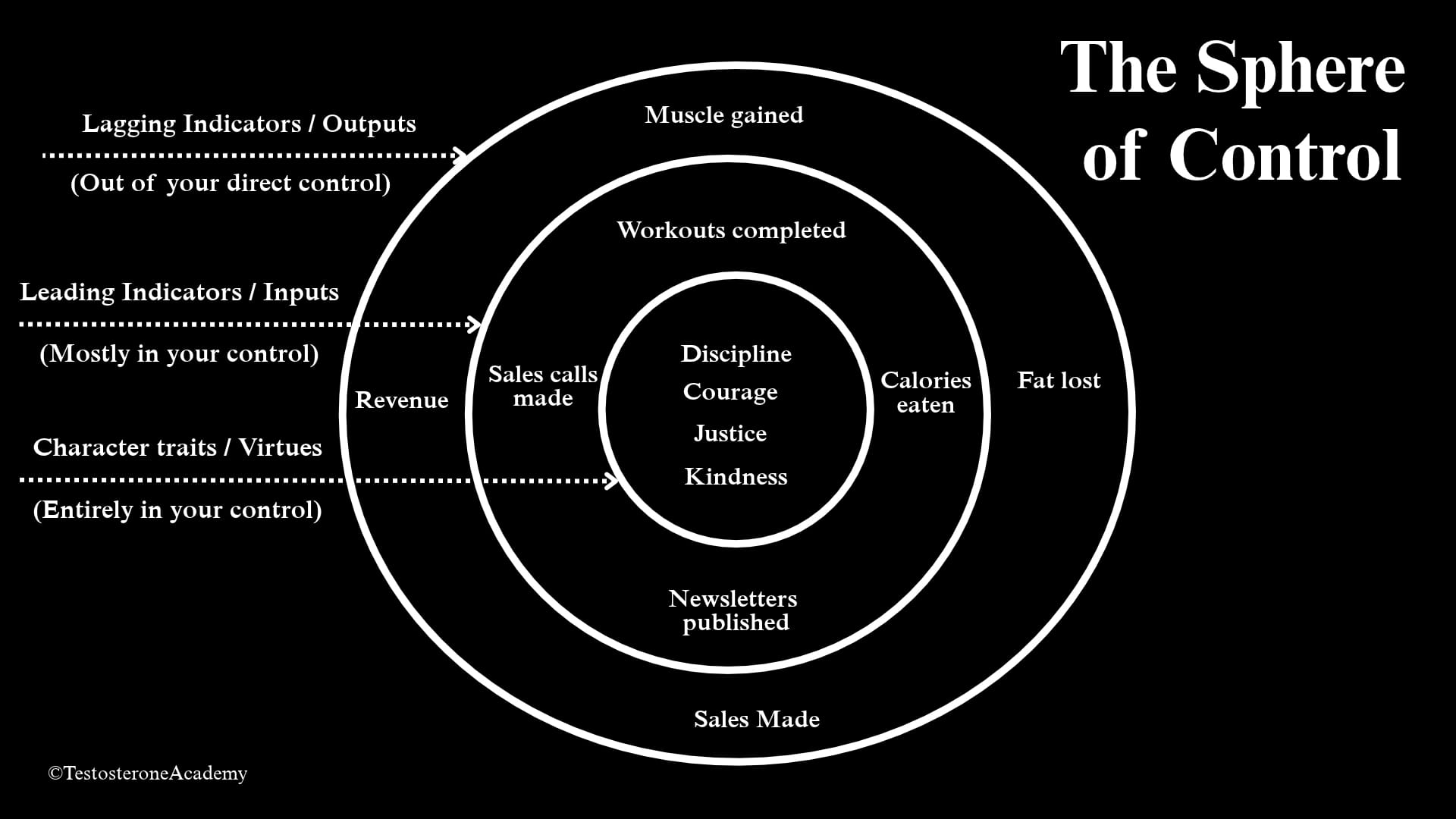
Once you've identified the inputs within your control, set your input standards. Base them on your best approximation of what gives you a reasonable chance of succeeding. If you aren't sure, research the benchmarks in your field. For example:
- Lift for one hour four times per week.
- Publish one newsletter per week.
- Make ten sales calls per day.
If you meet your standards regularly, you know you've "worked hard enough," and you were "disciplined," even when the outputs lag. You have no reasonable basis to beat yourself up because you did what you said you were going to do.
Be warned: lagging indicators almost certainly won't show up immediately. They might just need more time to compound. So give your goals a reasonable timeframe to appear based on educated estimates. For example, noticeable muscle growth and fat loss can take three to six months. Building a newsletter business can take two years.
If the results still don't show up in your estimated timeframe, don't despair. Pay attention: that's valuable feedback that something about your strategy is off. Make one educated adjustment, measure the result and try again. For example:
- Increase your working sets by one per muscle group.
- Drop your calories by 100 per day.
- Make fifteen sales calls per week instead of ten.
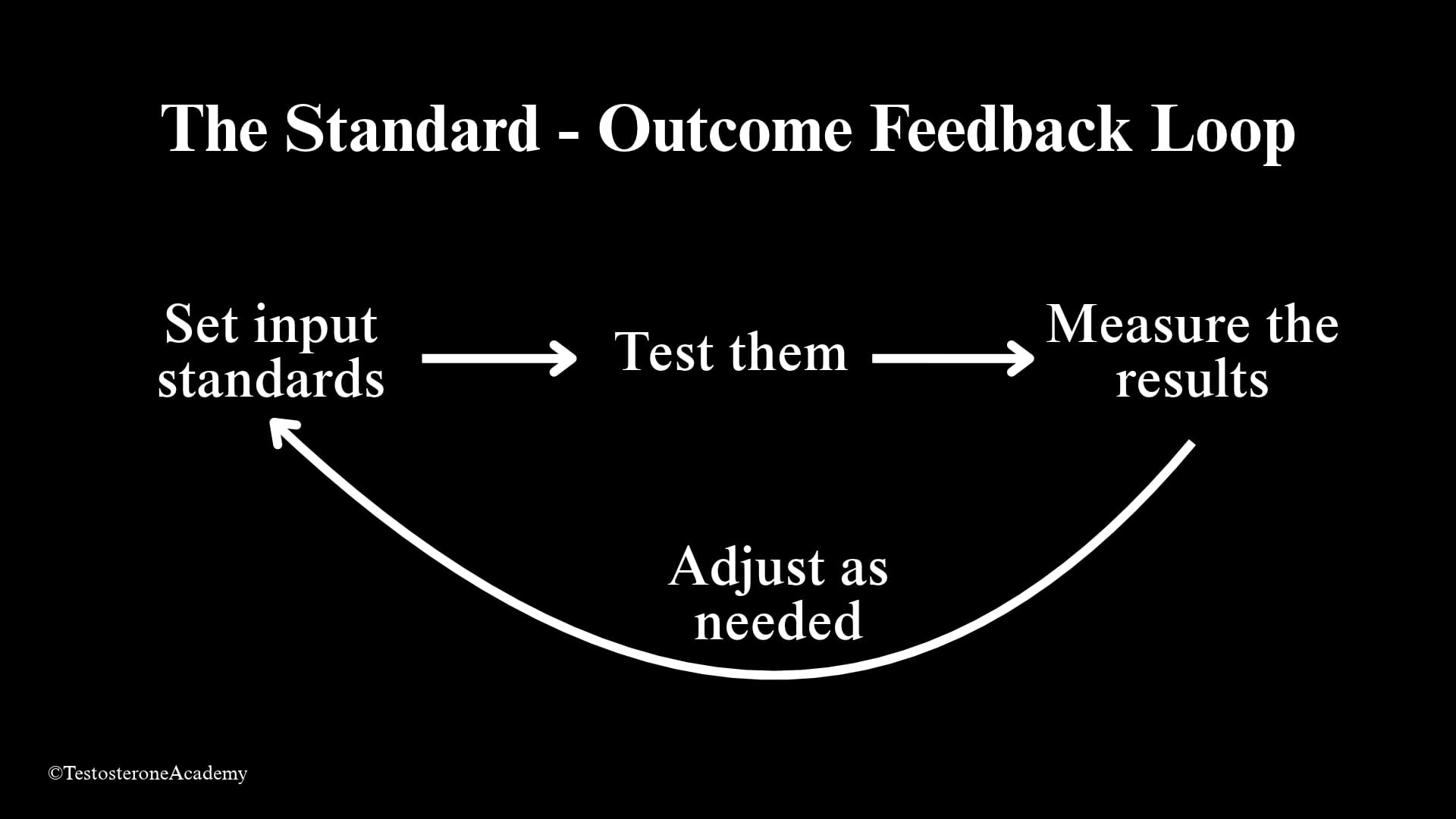
Remember: the answer isn't always more work, because doing more of something that isn't working (like crossfit for muscle growth, or sending newsletters through a broken domain) won't help. Make sure your plan is airtight before changing anything.
And only change one variable at a time, so you know what's actually driving the outcome. Don't drop your calories and increase your training volume simultaneously. Don't change business models and add another acquisition funnel.
All of this rides on having clearly defined standards. Without them, there will always be the open question about whether you worked hard enough.
Was five workouts enough this week? Was two hours of deep work sufficient today? Ambiguity is what gives self-reproach room to creep in.
But even if you fail to meet your standards, you still shouldn't beat yourself up. That would just distract you from what you should do instead: identify why you couldn't meet them, and what needs to change so you can next time.
The Three Causes of Input Failure
When you miss your standards, it's almost always one of three things:
- Your standards are unrealistic. Going to the gym two hours a day, six days a week, probably isn't sustainable. Seven hours of focused work on your side hustle while working a full-time job just doesn't fit on a calendar.
- There's too much friction. If the gym is 45 minutes away, the problem isn't your motivation. It's the commute. If you try to do focused work with slack open, even the most disciplined man is bound to get distracted. If you try to cut calories with chips in the cabinet, you're bound to cave eventually. Lower the friction to make the behavior easier to execute.
- You lack discipline (for now). Even if it genuinely is a work ethic problem, there's still no reason to beat yourself up. Discipline is a skill you develop over time, like anything else, and the feedback loop I just described — setting standards, trying to meet them, and identifying if/why you couldn't meet them — is how you build it.
Why Virtuous Men Are More Successful
"It can ruin your life only if it ruins your character. Otherwise it cannot harm you, inside or out."
— Marcus Aurelius
Beyond your input standards, your self-worth should ride on your character, which is distinct from your skills.
- You can be a generous man but an unskilled salesman.
- You can be a courageous man but an inexperienced entrepreneur.
- You can be a disciplined man but know little about fitness.
Your character is defined by how well you live up to your virtues, which are character traits that serve as a code of conduct for your behavior.
It's up to every man to determine for himself what his virtues are.
The Stoics had four cardinal virtues:
- Justice – act for the common good, and treat others as they deserve.
- Courage – never allow fear to stop you from doing what’s right.
- Temperance – discipline, moderation, balance, self-control.
- Wisdom – the governor of all other virtues, and the acquisition and application of knowledge.
On top of those, I've personally added these to my own list of virtues:
- Masculinity – be strong enough to lead, protect, and provide for others.
- Chivalry – be well-spoken, classy, respectful, and loving.
- Integrity – practice what you preach, and be a man of your word.
- Presence — self-awareness and being mindful of the present moment.
- Purpose — fulfilling your highest potential by giving your unique gift to the world.
Before reading on, write down 3-10 non-negotiable virtues that will form your personal code of conduct and that you'll ascribe your self-worth to.
Somewhat paradoxically, the man who ties his self-worth to his character is more effective and will be more successful than the man who attaches it to outcomes. Here's the logical reason why.
By definition, your "worth" as a man comes down to the value you bring to others.
If a "failure" causes you to mistreat your family, colleagues, clients, etc — because your self-worth is tied to outcomes, and you made yourself miserable over a perceived failure — then the net worth you're delivering to others is lower than it would be if you tied your self-worth to your character, didn't let the failure get to you, and showed up as the best version of yourself anyway.
Moreover, the virtuous man's progress is more consistent, because he doesn't tear himself down when his stats are down. His self-esteem doesn't collapse when his outputs change.
As a result, he performs better, because he preserves and redirects his bandwidth towards troubleshooting why they're down and correcting course.
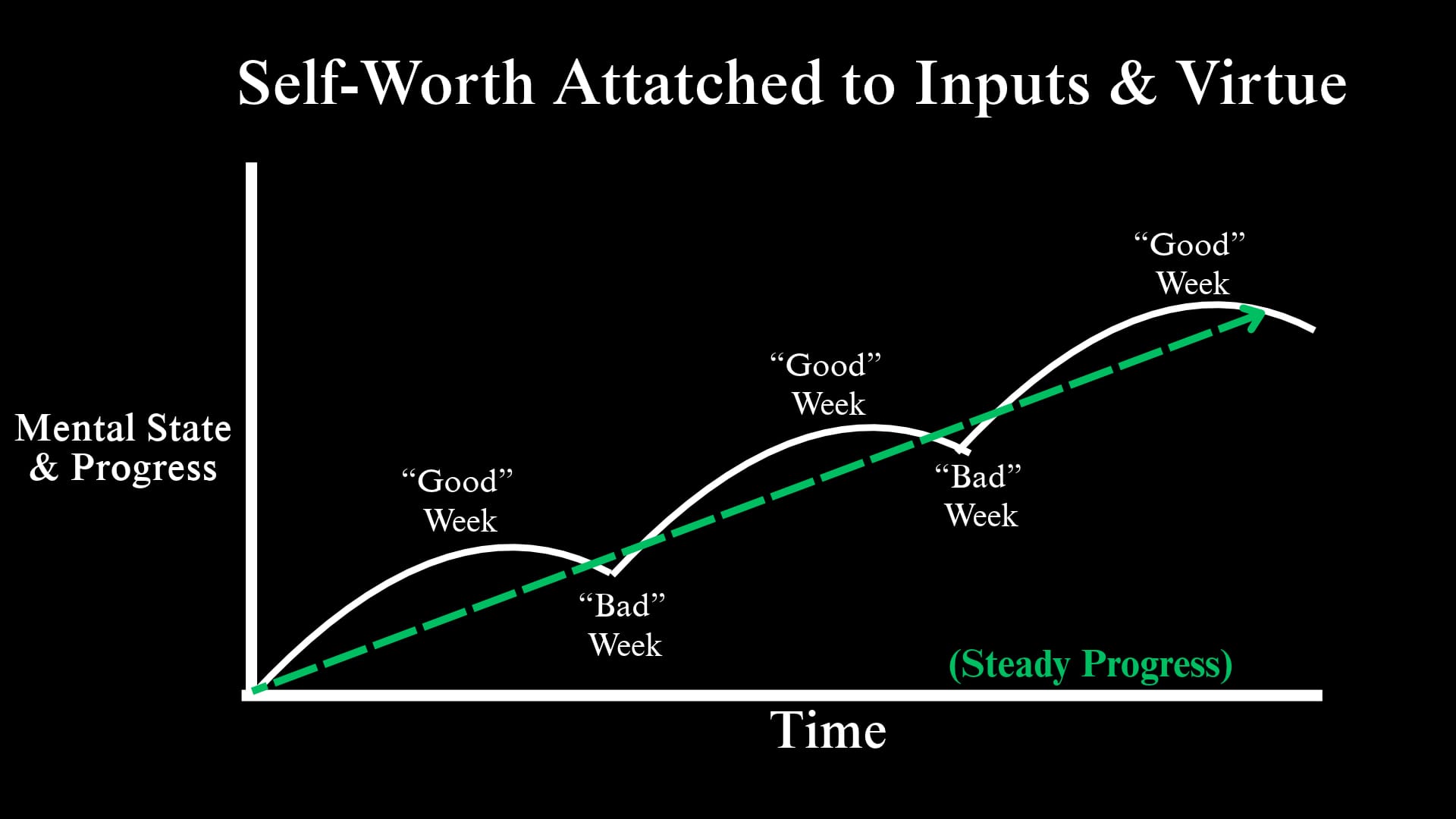
And since he stays composed when others spiral, he's more effective: at work, in the gym, and at 8pm with the people who matter most.
The winner effect is constantly working in his favor, because as long as he lives in accordance with his virtues, he considers himself a winner.
To a virtuous man, the only failure is not trying at all, giving up, or letting his reaction to an event disturb himself or others. Everything else is a data point.
Success aside, who lives a better quality of life? The man whose wellbeing is at the mercy of success, or the man whose wellbeing is grounded in something that's always in his power: being a virtuous man.
How To Measure Your Self-Worth
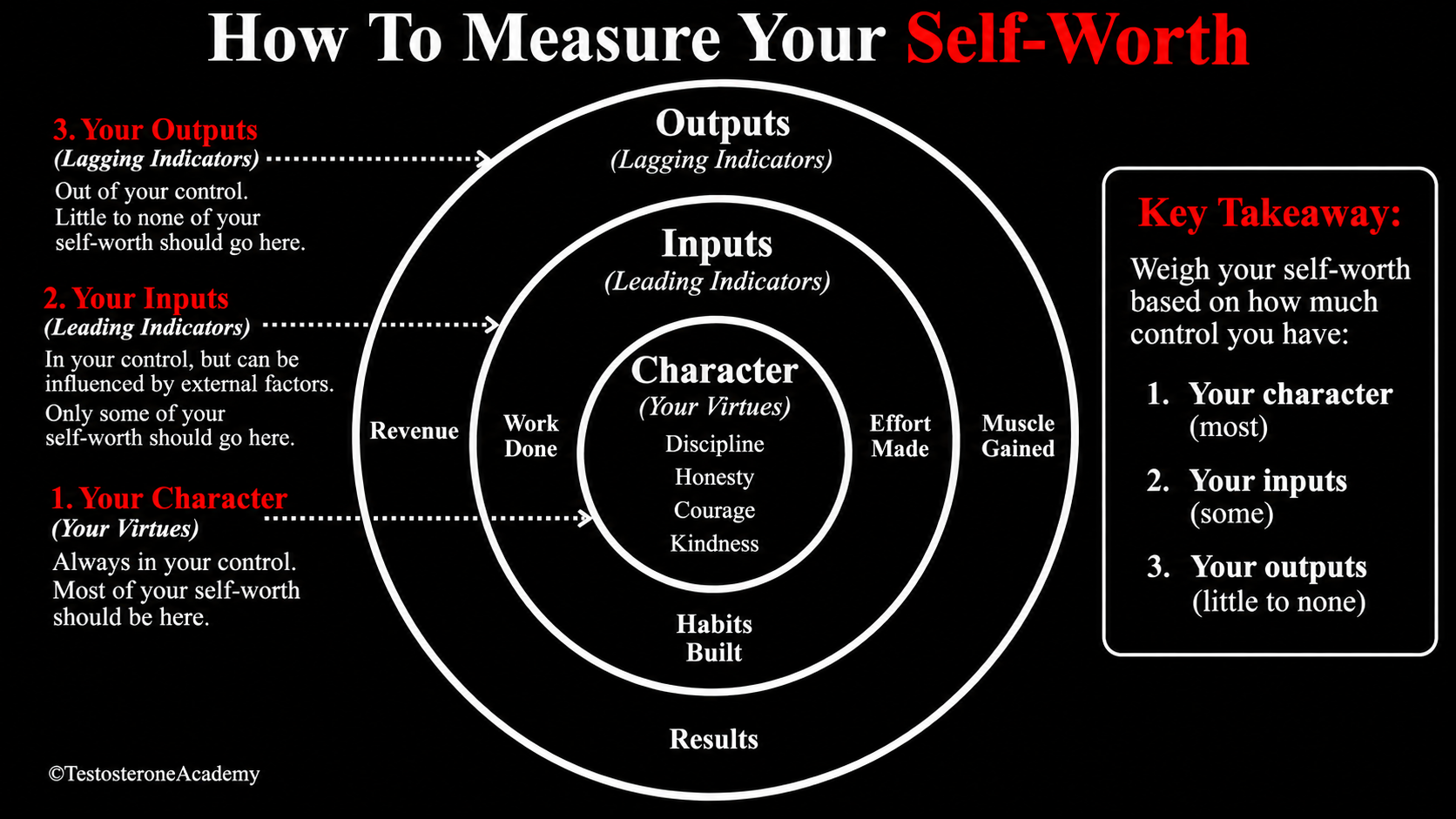
Therefore, your self-worth should be weighed in proportion to the level of control you have over the factors that influence it, in the following order:
- Your character (living up to your virtues): always in your control. Most of your self-worth should be here.
- Your inputs (leading indicators): in your control, but can be influenced by unexpected events, your skill level, miscalculating what “realistic” standards look like, and take some experience to calibrate. Only some of your self worth should go here
- Your outputs (lagging indicators). Little to none of your self-worth should go here, because you can only influence them, you can't directly control them.
What this looks like in practice
We'll use a hypothetical example of two salesmen to show how this could pan out in real life. Suppose ten sales calls a week was the standard each of them set.
Man #1:
He hit his input standards. Ten calls every week. He also behaved in alignment with his virtues (honesty, chivalry, discipline): he was honest on the calls, he didn't snap at his wife on the two evenings he was tired, and he went to the gym even though the month made him want to sit in the dark.
He earned nothing. By the logic most driven men follow, he “failed.” But he has no reasonable basis to feel like less of a man: he did what he set out to do, and he behaved like a man he'd be willing to vouch for.
The market simply didn't pay out yet, and that outcome doesn't move his self-worth.
Man #2
He hit his goal. He closed a big deal he'd been chasing by overdelivering a promise to a prospect, and the number in the bank account went up. Since his self-worth was attached to that number, it blew up his ego, so he skipped four calls that week, didn't deliver on his promise to his new client, and spent the evening of his “victory” drinking with the guys, all of which went against his virtues of discipline, honesty, and temperance.
He hit the output standard, but fell short on his input standards and virtues.
On paper, he's the success story.
The first man's revenue was zero and his self-respect was intact, correctly.
The second man's revenue was positive and his self-respect should have taken a hit, correctly.
Here's the story pans out over eighteen months, because the difference doesn't show up in just one.
Man #1
Month three: still zero sales. But he's unbothered because his virtue of Patience keeps him on course.
The old version of him would have beaten himself up with "sales are down because I suck at sales." Instead he looks at his scoreboard. He hit his calls every week. He lived up to his virtues every day. Effort is off the table, so the problem has to be strategy or skill.
That turns the zero from a character verdict into data.
He reviews his call notes and finds a pattern: every conversation dies at the same point, the moment he brings up price. He's pitching before he understands the prospect's problem, so the price looks like a cost and not a solution.
He changes one variable. For the first ten minutes of every call, he only asks questions. He keeps everything else the same: ten calls a week.
Month six: his first close. The market didn't change. He did.
Month nine: he finds the next bottleneck. He's calling a cold list of people who never asked to hear from him. So he makes one more adjustment and asks his first clients for referrals.
And they're happy to make connections, because he has lived up to his virtue of Justice and treated them well. As a result, his close rate climbs, because now he's talking to people who already trust him.
The whole time, the winner effect works in his favor. On his worst weeks he still scored high on his virtues, so by his own scoreboard he was winning. He showed up to every call like a man who had already won, and prospects could feel it.
He also never had a month where he was unbearable at home, because he lived up to his virtue of Chivalry, so his wife still respects him as much as he respects himself.
By month eighteen, he's a success internally, and on paper, because he measured his self-worth against his inputs and character, even when the results said otherwise.
Man #2
Month four: the market stops cooperating. Two deals fall through in the same week, and he has no one to follow up with because he made skipping calls on good weeks a habit, violating his virtue of Consistency.
His self-worth was riveted to his bank account, so the drop doesn't register as feedback. It registers as a verdict on him as a man: "I'm a fraud. That last deal was luck. I'm bad at sales."
He never asks why the deals fell through. If he had, he might have found that the client who felt lied to had been talking, and his reputation among prospects was stained by his dishonesty.
He perceives himself as a loser, his testosterone drops, and his mood, energy, and drive drop with it. He shows up to calls already apologizing. Prospects can smell it, and they don't buy from a man who doesn't believe in himself.
Every lost call confirms the label, which shapes the outcome of next call. The self-fulfilling prophecy is now in full swing.
Then he tries to whip himself out of it. "Work harder, you undisciplined wuss!" He jumps from ten calls a week to twenty a day as punishment. It isn't sustainable. Three weeks later he burns out, stops making calls altogether, and now he has confirmation of exactly what he's been calling himself: undisciplined.
He snaps at his wife on the evenings the numbers are bad, which is most evenings now. He drinks to numb the voice in his head, which costs him the next morning, which gives the voice more ammunition to call him undisciplined.
By month eighteen, he hasn't lost his skill. He's lost his belief in it. The ability to close deals is in him, but he's beaten himself so badly that he's forgotten that he has it.
Over the long run, the virtuous man wins. Not because the market rewards virtue, but because he never stopped trying, used failure as feedback, and never handed his self-respect to forces outside his control.
The market didn't beat Man #2. He beat himself.
Follow the action items below so your story unfolds more like man #1's.
Action Items
- Rewrite your identity labels: write down the self-flagellating labels you've been calling yourself, and rewrite each one as an objective skill you can build. Writing in the third person helps depersonalize the language.
- Example: "Joe has been labeling himself incompetent for struggling in his new role. Joe just needs to improve his coding."
- Describing reality in objective language does two things. It takes you out of the crosshairs of your own criticism, and aims it at your skills instead of your identity. And it opens the door to improving those skills, rather than identifying with them as permanent flaws.
- Define your locus of control: delineate what inputs are entirely in your control, and separate them from the outputs they influence.
- Set your standards: the inputs in your control, quantify in advance what success looks like so that you can measure your performance against your inputs, not the outputs. Then give your outputs a reasonable timeframe to show up, based on educated estimates.
- List your virtues: 3-10 non-negotiable character traits that form a comprehensive code of conduct that you'll vow to live up to. Even if you don't meet your performance standards, as long as you behaved according to your virtues, your self-worth remains intact. Every evening, rank how well you lived up to each on a subjective scale of 1-10, total your score, and work to increase that number over time.
- Weigh your self-worth by control: put most of it on your character, some on your inputs, and little to none on your outputs.
- Use "failure" as feedback: if your outputs don't show up in your estimated timeframe, identify the most likely reason why, change one variable at a time, re-measure, and repeat. If you miss your input standards, check the three causes: unrealistic standards, too much friction, or discipline you haven't built yet. Leave your self-worth out of it.
- Leverage the Winner Effect: interpret everything as a win: hitting your input standards, living up to your virtues, making measurable progress, and even coming up short, because when you do, you'll identify why and get one step closer to achieving your goals.
- Book a call if you want my help escaping the vicious cycle of self-flagellation once and for all.
By Joshua Vecchio: Certified Personal Trainer, B.S. Biology & Exercise Science, MBA