How to Make Yourself Unbreakable (The Stoic Method)

By Joshua Vecchio: Certified Personal Trainer, B.S. Biology & Exercise Science, MBA
Your boss lays an impossible deadline on your desk. An unexpected bill lands in your mailbox. Your business has its worst month in years.
"Why is this happening to me?" is the most expensive line you can think in moments like those, because it costs you the two things you need most during hard times: a clear head and a working plan.
But for most men, it's their default response to hardships.
There's a name for that kind of thinking.
It's called the victim mentality, and it causes you to perceive external events as if they were purposefully designed to make your life harder.
The victim mentality blinds you to solutions and makes you needlessly miserable, both of which cause your current problems to persist and make it more likely that future problems crop up as a result of your ineffectual response.
Destructive as it is, it's not your fault that you default to the victim mentality.
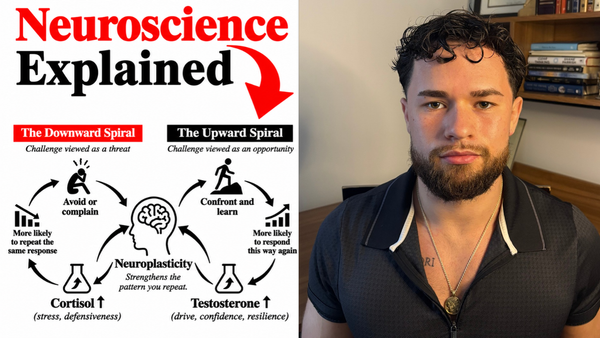
When you're in the midst of a hard situation, the stress hormone cortisol makes it harder to access your prefrontal cortex, the part of the brain involved in rational thinking, decision making, and emotional regulation.
Your perspective narrows as your attention fixates on the problem, which detracts from your ability to think logically and come up with creative solutions.
That and unless you deliberately train yourself not to, you're susceptible to subconsciously adopting the victim mentality, because it's running rampant in our society today.
People love to lament the economy for their financial situation, blame their kids for their unhealthy eating, sleeping, and exercise habits, and loathe the political climate for every injustice they face.
The central error of the victim mentality is an inaccurate perception of reality in which one takes everything personally, as if the world were out to get them, and views every challenge as a bad thing.
At the heart of the victim mentality lies extreme self-centeredness: operating as if the world revolves around you and everything that seeminly doesn't go your way is an intentional curse from the universe or society.
Going about life with the victim outlook makes you unnecessarily stressed, emotionally reactive, pessimistic, and hampers your ability to deal with challenges effectively.
Fortunately, there's a mental model you can use to permanently escape the victim mentality and view all occurrences accurately, realistically, and logically, protecting your sanity and making you better able to take on challenging situations effectively.
And as you'll see, no matter what you're going through, this worldview makes you quite literally invulnerable to hardships, because its applicability is universal.
In this article, I'm going to show you how to adopt it to your situation.
To find that mental model, we need to time travel back to ancient Rome.
If at any point you want my help applying it to the hardships you're facing, feel free to book a call.
The Worldview Behind Every Stoic Tool
Stoicism is an ancient philosophy that originated in Greece and was refined by the Romans into a practical practice designed to help navigate life's difficulties.
Stoicism's most famous adherent, Marcus Aurelius, practiced Stoicism religiously to bear the challenges of leading the most powerful civilization on the face of the planet.
Stoicism has a vast armament of tools for mental resilience, but they're all based on a worldview called the logos (the Latin root of our English word for logic).
Logos refers to the way all events transpire as the result of prior causes in an infinite, unbreakable chain of cause-and-effect.
For example, the thread of cause-and-effect that led to you reading these words went something like this:
Big bang → Milky Way → Earth → unicellular organisms → multicellular organisms → mammals → primates → homo sapiens → your great-great-great grandparents → your parents → your childhood → the decisions you made years ago → the decisions you made months ago → weeks ago, days ago, hours ago, minutes ago, seconds ago, to now.
You can conceive of the logos as the domino effect at the cosmic level.
While its origins are ancient, the logos is perfectly compatible with our modern scientific understanding of how the world works.
It is true that everything in our current reality is the end result of the events that came before it, and is the impetus for the events that will come after it.
The growth of a tree is the result of a seed that was planted years prior.
Cause: a planted seed. Effect: a tree grows.
Muscle growth is the result of regular strength training.
Cause: regular strength training. Effect: muscle growth.
Since it's in alignment with the nature of reality, the logos doesn't require you to believe anything that's not grounded in hard science. You don't have to convince yourself that some god is calling the shots.
Its name describes itself: logos is an inherently logical worldview.
Knowing that can give you the trust to believe in it with conviction.
Now that you know what the logo is, onto how it makes you invulnerable.
Nothing is Bad
“Why should we feel anger at the world? As if the world would notice.”
— Marcus Aurelius
Our brains evolved to interpret anything that could be a threat to our survival as “bad,” and worthy of mounting a stress response against.
That mechanism was helpful for the survival of our ancestors because it primed them to fight or flee with their bodies, not think with their brains.
The problem in the modern world is that we almost never need to fight or flee from our stressors. We need to think clearly about how to resolve them.
And unless we deliberately train ourselves not to perceive day-to-day stressors as threats to our survival, our fight or flight response can't distinguish between a bill from the IRS and a saber-toothed tiger.
Fortunately, the Stoics found an off switch.
The logos proves that nothing is inherently “bad,” — the label that causes us to perceive hardships as threats to our survival and sets off our fight or flight response.
Because if it's true that every occurrence is purely the result of prior causes, then there can be no such thing as “good” or “bad.”
Everything that happens is simply one objective occurrence in the grand scheme of an infinite chain of cosmic cause and effect.
In that context, an unexpected bill isn't “good” or “bad,” the same way lightning striking a tree isn't “good” or “bad.”
“Good” and “bad” are just labels we ascribe to situations that our primal brain regions perceive to be beneficial or detrimental to our survival.
Even if the hardship you're facing is a genuine threat to your quality life, or even survival, like a financial crisis or a terminal illness, the key reframe that makes it sting less is that the situation you're facing isn't personal.
The world isn't out to get you.
The meteor that took out the dinosaurs didn't “intend” to cause one of the greatest extinction events in the history of life on Earth. It just so happened that its trajectory intersected with planet Earth.
Likewise, whatever challenge you're facing is just the natural byproduct of an infinite chain of prior causes, and it's up to you to decide how to interpret that fact. That's why, according to the Stoics, “good” and “bad” are only found in how we choose to perceive events that are themselves purely objective, a practice they called the discipline of perception.
When we are undisciplined in our perceptions, we cause ourselves unnecessary stress by labeling objective events as “bad,” an error psychologists call catastrophization.
Catastrophization: When Your Brain Blows It Out of Proportion
Catastrophization, by the way, is usually far more dramatic than “bad.” When it takes over, your thoughts probably sound more like:
“This is the worst thing ever.” “That's so unfair.” “What a nightmare.”
Catastrophization goes hand in hand with the victim mentality. When we think the world is out to get us, we're more likely to blow things out of proportion.
For example, I once got an email from my manager informing me of pay cuts that were totally unjustified.
I was enraged. My fiancée had just lost her job, so our situation was already tight.
When I saw what the pay cuts would do to our savings rate, I hurled a bottle of almond milk across the room in a fit of rage.
“I can't believe he's doing this to us!”
In that moment, I failed to realize that, although they were baseless, the pay cuts weren't a personal affront, and that, even though they may have made our financial situation more challenging, they weren't inherently “bad.” They were just the result of the causes that came before.
The antidote to catastrophization is decatastrophization, which involves stripping away the language our minds use to describe events as “bad” to land on an accurate description of the same event that's grounded in reality.
Instead of thinking: “I can't believe he cut my pay, that's so unfair!” (victim mentality), and“what if we go broke?” (catastrophization)...
I should've thought: “My pay was cut.” Period.
“I now need to assess our options to improve our financial situation.” That's it.
Everything that's not an objective fact of reality is removed. What's left behind is radical realism; the only unbiased source of truth there is.
Decatastrophization is not only more realistic and less stress-inducing, it's also more actionable, because it shifts your focus to what's in your control.
Understanding the logos is the most direct way to make decatastrophization accessible, because when you view your current situation from the perspective of the chain of events that led to its occurrence, it becomes abundantly evident that your situation isn't “bad,” it's just another event that occurred in the thread of cause and effect.
Furthermore, you can leverage your understanding of the logos to follow the thread of cause and effect into the future to forecast how your potential solutions to the “problem” at hand could play out, helping you land on the one with the highest potential to be most effective. More on that later.
One more thing worth pointing out...
Suppose, hypothetically, that the pay cuts were a personal affront — my manager rolled them out because he got some sadistic pleasure out of making people's lives harder.
Even that isn't inherently bad, because whatever events transpired in his life that made him the type of person who got sadistic pleasure out of making other people's lives harder were themselves chance events in the chain of cause and effect that led to his decision to cut pay.
So his actions should be viewed with the same indifference as a rainstorm: the storm didn't decide to start raining to make us wet and uncomfortable. It was a predictable effect of the causes that preceded it.
Nothing to Fear From a Challenge
Going one layer deeper, even though the pay cuts made our financial situation more challenging, challenges themselves aren't “bad” either. They're just challenges. Just like being uncomfortable from getting wet in a rainstorm isn't “bad.” You're just wet.
Do you see how far you can take this worldview? Its applicability is literally infinite, because everything that happens in the present is just one of an infinite number of events that have happened in the past, and will transpire in the future.
None of them are bad. All of them just are. The beauty of the logos is that it's true. You're not forcing yourself to believe something that conflicts with reality. You're conforming your perceptions to reality.
You're viewing reality as it actually is: undistorted by your reactions to it.
When you view every event as a realist, you become invulnerable to “hardship” because nothing is bad to you. Everything just is.
Events only become bad when your mind describes them as such.
And you always have the free will to choose to view events for what they truly are: objective occurrences in the grand scheme of cosmic eternity.
That's the discipline of perception at work. And the objective, realistic judgement it enables can be boiled down to six words: nothing is bad, everything just is.
But why stop at nothing is bad when you can view everything as good?
“Things wait outside us, hover at the door. They keep to themselves. Ask them who they are and they don't know, they can give no account of themselves. What accounts for them? The mind does.” — Marcus Aurelius
Everything is Good
The Stoics believed that, when the entire context of the past, present, and future is taken into consideration, every occurrence is ultimately “good,” meaning, the culmination of all events advances the world at large in a harmonious way, even if the event at hand may seem detrimental to the individual it's happening to.
And again, this isn't some “positive thinking” exercise that forces you to believe some blindly optimistic confabulation of reality.
It's baked into the nature of reality.
A simple example of this in the natural world is evolution by natural selection, whereby only the fittest members of a species survive and reproduce.
Imagine a famine wipes out 90% of a herd of camels, leaving behind only the 10% with a genetic mutation that gave them a hump of stored fat, enough to get them through it.
The survivors then reproduced and passed on those hump-generating genes to their offspring, improving the next generation's chances of surviving a famine.
Even though it seems unfortunate that 90% of those camels died out, the famine ultimately led to the betterment of the species as a whole. You just have to zoom out far enough — beyond the famine and into the next generation of camels — to recognize that.
This concept shows up in my almond milk situation as well.
In the moment I hurled that bottle of almond milk across the room, I was oblivious to the fact that those pay cuts were one of the best things that ever happened to me.
After my initial reaction subsided, I realized something that I had forgotten: I made almost two times as much per hour as a personal trainer as I did as a crossfit coach (the role that was receiving pay cuts).
If I doubled down on growing my personal training clientele, I could've made twice the money in the same amount of time, which would've freed up time and bandwidth for me to build the career I actually wanted: this men's coaching business.
If it weren't for those pay cuts, I probably would've mindlessly continued coaching crossfit for half the pay, leaving me with less time and energy to build my business.
Just like the famine did for the camels, those pay cuts forced me to adapt and evolve. Even though the situation seemed like a negative in isolation, from the perspective of the logos, it became clear that the events that followed led to a net positive.
Hidden advantages like that are called silver linings, and they're there to be found in every situation. You just have to go looking for them. That part is essential.
If I didn't sit down with the numbers to actively look for a better opportunity, I would've just accepted the pay cuts and made even less per hour than I was before.
Viewing situations from the perspective of the logos makes better opportunities easier to find.
By zooming out and looking at your situation within the context of the events that preceded it, and those that will follow, you'll almost always find a way to reframe it to your benefit in the end.
The logos also holds you accountable to your contribution to the creation of your situation, and makes you aware of character flaws you might otherwise ignore.
Maybe your genetics aren't the reason you're in bad shape. Maybe your boss didn't demote you just to make your life harder.
If you follow the thread of cause and effect back in time, you might find that your inconsistency in the gym, poor diet, and repeated missed deadlines had something to do with your current situation.
The point isn't to beat yourself up. It's to gain clarity on why events unfolded the way they did, how you might've contributed, and to use that feedback to inform your behavior moving forward: hitting all of your weekly workouts, sticking to your diet, and nailing your deadlines.
But there aren't always direct silver linings, better opportunities, or character flaws to be found. Sometimes, situations seem to just plain “suck.”
Suppose your house got struck by lightning and burned down.
How could that possibly be “good?” There's no higher hourly rate hiding on the other side, and no character flaw of yours that caused it.
The Stoics had an answer for situations like those too.
The Silver Lining That's Always There
No matter how “bad” or “unfair” a situation may seem, there's one silver lining that's always available to exploit: every situation presents an opportunity to exercise the skills and character traits needed to handle it well.
If your house burned down, you could either despair for weeks and let it ruin you emotionally, or you could choose to remain unfazed and spare yourself self-inflicted distress.
In my case, those pay cuts afforded me the chance to exercise emotional regulation, adaptability, critical thinking, planning, and executive function.
The skills and traits you build then transfer to future situations, as does the habit of deliberately using every situation as an opportunity to develop your character.
This is the “what doesn't kill you only makes you stronger” mentality in action. (If that interests you, I went DEEP on how to apply it in last week's piece).
The Discipline of Action
The Stoics called this practice the discipline of action — how you choose to respond to events after you've perceived them accurately using the discipline of perception.
And once again, viewing situations through the lens of the logos makes the discipline of action (using all events as opportunities to grow stronger) more accessible.
It's much easier to identify the skills and traits a situation demands of you when you drop back and account for what caused the situation, and what its future effect will be depending on how you respond to it.
For example, if you got laid off because your company is downsizing, and your skillset is easily outsourced to AI, that makes it clear that you weren't let go because you lacked effort, or because your boss is mean.
Therefore, to handle the situation effectively and set yourself up well for the future, you don't necessarily need to work harder, but rather, update your skillset.
If you didn't take the logos — prior causes future outcomes — into account, you may be so distraught by being let go that you never identify the real reason you were let go, or the best way to proceed, so you never evolve, and stay unemployed.
From that lens, it may seem as though “nobody is hiring,” or “the economy is bad,” and that there's “nothing you can do” to find a job, when in reality, you have more control over your situation than you realize. You just need to examine your logos: the chain of cause and effect that led to where you are, and how your interaction with that chain in the present will influence how it unfolds in the future.
If your life hasn't unfolded the way you've wanted it to, you can book a call and I'll help you design a better future.
With all that being said, I'm going to distill the concept of the logos into a 3-move framework you can deploy the next time an unexpected bill hits your checking account, you get let go, or your house burns down.
Your Three Moves: The Full Practice
In every moment, your personal logos — your subjective experience of reality in the present — is unfolding as a result of the events that preceded it.
According to the Stoics, your job as a rational being is to do the following, in order:
- Exercise the discipline of perception — view every occurrence as an objective event in the infinite chain of cosmic cause and effect. Nothing is “bad,” everything is “good.” Doing so will keep your interpretations of reality unadulterated by the victim mentality or catastrophization, enabling you to respond appropriately.
- Exercise the discipline of will — there are three categories all events fall under: those in your control, those you can influence indirectly, and those completely out of your control. The discipline of perception enables you to clearly identify which category each event falls under. For events that are entirely out of your control (like your house burning down), the discipline of will asserts that you should willingly embrace it and use it as an opportunity to develop your character (by training yourself not to get upset, for example).
- Exercise the discipline of action — for events that you can partially influence, or fully control, your move is to handle them as effectively as possible by identifying how your past actions may have contributed, how your present actions will influence future outcomes, and using that information to determine your response.
Effective execution of all three disciplines is contingent upon you adopting the logos as your worldview: everything is a product of a chain of cause and effect, and within that chain, you can always control how you choose to respond to the events within it.
And when you do adopt the logos as your worldview, you become invulnerable, because nothing can affect you emotionally when you view it objectively, and everything that happens becomes a cause that leads to the effect of you growing stronger.
That's why the Logos was the throughline for all other Stoic frameworks.
Always define whatever it is we perceive — to trace its outline — so we can see what it really is. Stripped bare. As a whole. Unmodified. And to identify what qualities I need to bring to bear on it — tranquility, courage, honesty, independence, or what? Nothing is so conducive to spiritual growth as this capacity for logical and accurate analysis of everything that happens to us.
— Marcus Aurelius
From Victim to Victor
The man who says "why is this happening to me?" when he encounters a hardship is asking the wrong question.
Remove two words and replace one, and the question becomes useful: "how did this happen?”
Follow the thread of cause and effect back far enough, and the answer becomes clear: it's either a chance event that's out of your control, or the quiet result of your past actions, or lack thereof.
In either case, your response is the same: use the present situation as opportunity to make your future better.
Whether that means training yourself not to let hardships disturb you by viewing them as the objective events they truly are, or taking responsibility for your past to create a better future for yourself. That's the disciplines of will and action in action.
And the thread of cause and effect that ties the disciplines together is the logos.
It has no opinion about you, which is exactly what makes it freeing: nothing that happens is personal.
The layoff, the bill, the diagnosis, the call from your kid's school: these are events in a chain that started long before you and will keep going long after.
When you zoom out and see where they've come from and where they'll go, it's much easier to interpret them realistically and handle them effectively.
From the lens of the logos, nothing is bad, and everything is good.
Because events don't happen to you: the world isn't out to get you.
They happen for you: as opportunities to become wiser and more resilient.
Action Items:
Start small. The next time you get cut off in traffic, caught in the rain, or get sick, remind yourself that it's not a personal curse. It's just something that happened in the grand scheme of cause and effect. Letting it upset you will cause you to become a more reactive person in the future. Using it as a chance to apply the logos worldview will take the sting out of the inconvenience. It will also make applying the logos a mental habit, so it is more likely to come online when higher stakes challenges come to pass.
Speaking of higher stakes challenges, in the following exercise, you'll frame the hardest situation you're currently going through in the context of a cohesive narrative that begins in the past, arrives in the present, and continues in the future.
The goal is to make the logos chain visible to help you realize that your current situation is an objective that's just the natural result of the events that preceded it, and to help you see how everything that happens is ultimately to your benefit if you choose to make it so. Do this:
- Identify one hard situation you're currently facing, and describe the past causes that gave rise to it.
- Describe the situation in the most objective, realistic language possible. Writing in third person helps with that.
- Identify any and all hidden silver linings, as well as the character traits you can use the situation as an opportunity to develop.
- Write out how you can handle the situation as effectively as possible, and how it could unfold for your benefit in the future if you do.
Example:
Objective perception: Josh is currently facing pay cuts that are putting his income below the amount needed to hit his target savings rate. The pay cuts are not designed to make his life harder.
Follow the thread backwards: The pay cuts are happening because the company he is working for is reallocating funds to increase its profitability. They are doing that because the economy is down and they need to avoid going under. The economy is down because... (you can go all the way back to the big bang if you want).
Silver linings: The pay cuts made Josh realize that if he resigns from his current role and focuses entirely on personal training, he can make the same amount of money in half the time, allowing him to put more effort into his side business.
Skills & traits needed: To handle the pay cuts well, Josh needs to exercise the following skills and character traits: the emotional regulation to perceive the pay cuts objectively, the courage to resign, and the executive function to become his own boss, all of which will make him a more effective entrepreneur.
How the future unfolds: If Josh exercises courage to step down from crossfit coaching and improves his sales skills to replace that income with personal training revenue, he'll have more time and energy to build his own business faster, advancing his fulfillment of his highest contribution to society. For that, Josh is grateful for the pay cuts.
I'm only able to describe my logos so well because I'm on the other side. When you're in the throes of a hard time, it can be challenging to find the good in it.
In all my experience as a coach, and working with mentors myself, I've found that having an outside perspective is invaluable for seeing events realistically.
So if you want help overcoming whatever hardship you're struggling through, book a call and I'll help you create a favorable future.
Be well,
Josh
By Joshua Vecchio: Certified Personal Trainer, B.S. Biology & Exercise Science, MBA