The Hidden Reason New Dads Get Exhausted And Out Of Shape (According to Science)


The average father in 2026 has a dad bod, is constantly exhausted, and has no sex drive, but it's not just because most fathers don't exercise or get enough sleep. I know because I've worked with dozens of fathers as a Personal Trainer and Men's Health Coach.
I also know something that very few fathers are aware of: sub-optimal testosterone is directly implicated in most of their problems.
Testosterone is a key mediator of body composition. It simultaneously facilitates muscle growth and fat loss (2). The "dad bod" isn't just the convenience snacks. It's also a loss of the hormonal sculptor of your physique.
Testosterone brings about mental energy and sharpens cognitive function (5). The chronic fatigue that makes it hard to stay awake after 3pm isn't just disrupted sleep. It's also disrupted hormones.
Testosterone also drives libido (9). Your sexless marriage isn't just the kids getting in the way. It's also a lack of the biological impetus that fuels your virility.
Given its importance in man's quality of life, all men should be aware that fatherhood decreases testosterone (4). You read that right. Having kids decreases your testosterone levels.
But there's a key nuance. It's not the fact of being a father that decreases testosterone.
To be more precise, it is the act of over-investment in direct, hands-on childcare that drives fatherhood-induced testosterone declines (4).
Thus, the very aspects of being a devoted, involved, loving father that your pride yourself on may actually be exacerbating the testosterone declines that come with fatherhood, paradoxically negating your ability to be the best father possible.
Because research also shows that the offspring of fathers with low testosterone have worse health scores (1).
The wellbeing of your family is at stake as well.
You will walk away from this article with a thorough understanding of:
- The research surrounding the influence of fatherhood on male testosterone levels.
- The underlying reason why fatherhood causes testosterone decline.
- How modern family structures and lifestyles can exacerbate these declines.
And if you want to shed the dad bod, sharpen your mental energy, and restore your sex drive without a lifelong TRT prescription, book a strategy call and I'll show you the exact framework I use to help career-driven dads reverse testosterone decline naturally.
Without further ado, let's dive into what the research says about how fatherhood can cost you your testosterone levels.
Does Fatherhood Decrease Testosterone?
Research consistently finds that fathers tend to have lower testosterone levels than nonfathers, but the size of the difference varies considerably across studies and populations (7).
The most influential study on this topic, titled Longitudinal evidence that fatherhood decreases testosterone in human males, followed 624 young Filipino men for approximately 4.5 years.
Men who became partnered fathers experienced reductions of approximately 26% in morning testosterone and 34% in evening testosterone, which were substantially larger declines than men who remained single and childless.
This study is particularly cogent for a few reasons.
The first is its longitudinal design.
Unlike earlier cross-sectional studies, which compared testosterone levels between fathers and non-fathers, this study compared testosterone levels in the same men before and after they became fathers — ruling out the effect of individual differences between men like age and genetics.
It also accounted for the effect of self-reported sleep quality and ratings of psychosocial stress — both of which can significantly decrease testosterone levels and are commonly concurrent with fatherhood. This adjustment weakens the possibility that sleep and stress influenced the results.
While these design features provide substantial evidence that fatherhood itself was likely the primary driver of the declines, it could not completely rule out other influences like changes in body composition, physical activity, diet quality, alcohol intake, relationship dynamics, or other lifestyle factors.
Given the profundity of its findings and soundness of its design, this study is often trumpeted on social media as the headline "fatherhood decreases testosterone by 30%."
Not so fast. Although this is a strong study, it's not perfect.
This study only involved young Filipino men from a specific ecological and cultural environment. Testosterone biology is also strongly influenced by body composition, general health, family arrangements, and patterns of paternal involvement, so the size of the reported declines may not transfer directly to all populations.
Moreover, this is just one study. It's crucial to examine the entire body of literature on a given topic before drawing universal conclusions.
The best way to go about that is to examine a meta-analysis — a "mega" study that amalgamates findings from many studies into a cohesive narrative.
The two most prominent meta-analyses on the relationship between fatherhood and testosterone reported somewhat conflicting results.
A 2019 meta-analysis by Grebe et al. synthesized 114 effects from 66 studies and found that fathers had substantially lower testosterone levels than childless men (6).
But another meta-analysis published later that year using 50 outcomes from 7,080 participants found only small or inconsistent effects of fatherhood on testosterone levels (7).
Putting this all together, when the findings from all of the studies are averaged out, the difference in testosterone levels between fathers and nonfathers is real and measurable, but highly variable and context dependent.
Why Some Fathers Lose More Testosterone
The most important contextual variable that determines the extent to which fatherhood decreases testosterone is the amount of time a father spends in direct contact with his offspring.
Gettler's study showed that fathers reporting 3 or more hours of daily childcare had significantly lower testosterone levels than fathers who were less involved in direct care (4).
Another study mentioned in Meijer's meta-analysis showed that among Datoga pastoralists, fathers who spent most of their time away from their families had testosterone levels comparable to those of non-fathers (8).
In other words, it's more accurate to say that infant exposure decreases testosterone, not necessarily the state of being a father.
More evidence supporting this notion reveals itself in other studies showing that testosterone declines are most robust during the prenatal period and the first few years of childhood, but as infants mature into adolescents, the testosterone-suppressing effect of fatherhood appears to wane and testosterone levels rebound (7).
That said, the average age gap between siblings in the United States is about 2.5 years, so men who have more than one child at this cadence could be predisposed to half a decade or more of significantly suppressed testosterone levels.
The key takeaway from this section is that the degree to which having children decreases a father's testosterone levels is highly context dependent, with the most salient driver of declines being the amount of direct childcare he is involved in.
This begs the question: why does infant exposure decrease testosterone in fathers? What is the purpose of this mechanism?
How & Why Babies Decreases Testosterone
Researchers aren't entirely sure how infant exposure decreases testosterone. It probably has something to do with visual and auditory cues, physical contact, and potentially pheromone effects.
The why is far better understood.
Testosterone declines in fathers supported the survival and reproduction of the human species during our evolutionary history.
While testosterone has a litany of functions, its primary role is to encourage "Reproductive effort." "Reproductive effort" doesn't just refer to the physical act of reproducing. It encapsulates all of the traits and behaviors that ultimately lead to mating success from both social and physical standpoints, including risk-taking, status-seeking, social dominance, competitiveness, sex drive, muscular development, etc.
That's why females tend to selectively mate with males with higher testosterone levels, because they often possess traits that make them more adept at protecting and providing for them and their offspring, thereby propagating the continuation of the species as a whole — evolution's ultimate objective.
Consistent with this narrative, Gettler's study showed that men who ended up becoming fathers had higher initial testosterone levels than men who did not become fathers.
Yes, dads had higher baseline testosterone levels than other men before having kids.
But like all things in biology, there's a tradeoff.
The traits and behaviors of high-testosterone males that make them attractive and successful at reproducing (provisioning ability, social dominance, risk-taking, mate-seeking, etc) typically conflict with those that make a man an involved father (selflessness, tenderness, patience, attentiveness, etc).
This evolutionary theory is supported by preliminary research among fisher-farmers in the Republic of the Congo which elucidated an inverted U relationship between a father's testosterone levels and the health of his children.
Fathers on the very high-testosterone end of the spectrum had lower children's health scores, because testosterone discourages parenting effort in favor of reproductive effort.
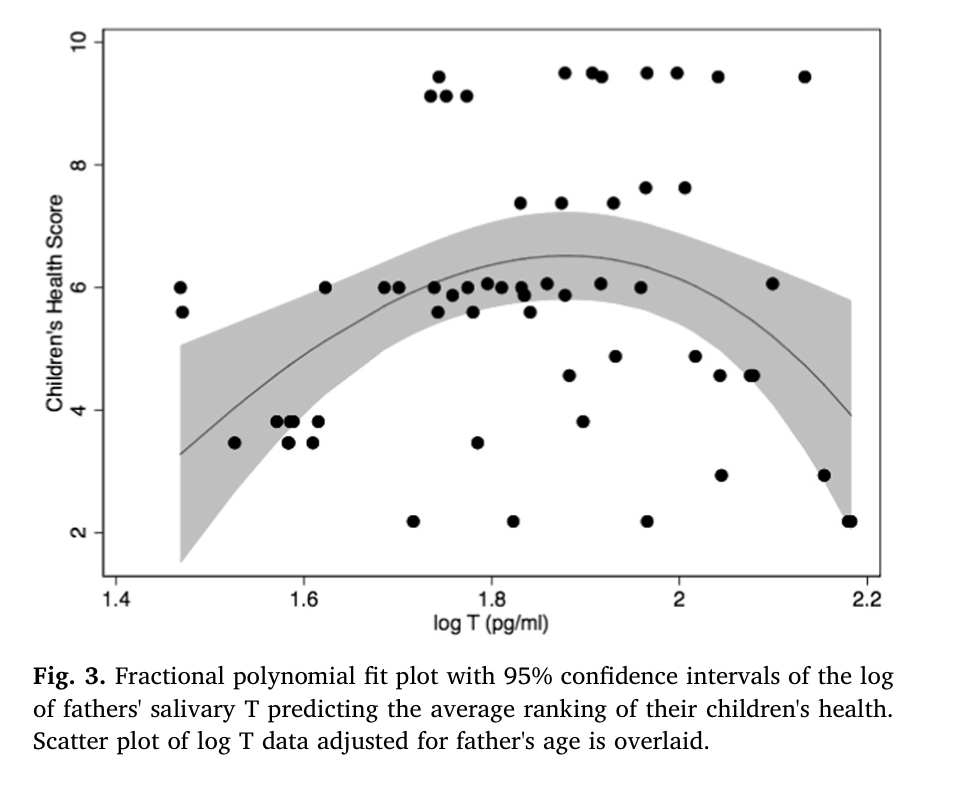
Thus, the most likely explanation for why fatherhood, or to be more specific, infant exposure, decreases testosterone, is that this mechanism served to shift a father's priorities away from reproductive effort (e.g. foraging, fighting, and doing something else that starts with an F), to parenting effort (caring for his current offspring).
This shift in priorities is especially important for social species that live in groups (like humans) because we are K strategists, meaning our evolutionary strategy is to produce fewer offspring but invest heavily in their survival. We prioritize offspring quality over quantity.
For this reason, it takes the efforts of a mother, father, and the rest of the tribe, to successfully raise a human child.
Therefore, high testosterone drives men to reproduce, but once they do, nature tones down testosterone a bit, because at that point, the propagation of the human species is better served by fathers protecting, providing for, and parenting their current offspring, as opposed to risking their lives and pursuing more mates.
So yes, fatherhood-induced reductions in testosterone were instrumental in our evolutionary past. And that's exactly why this mechanism exists.
Although this mechanism exists for good reason, the modern world creates circumstances that can take fatherhood-induced testosterone declines to the point of excess, which can contribute to low testosterone and negatively affect the quality of life of fathers, their families, and society at large.
Modern Family Structures Exacerbate Fatherhood-Induced Testosterone Declines
Throughout human evolution, women didn't raise children all by themselves. Mothers received most help with hands-on nurturing from other women in their tribe, including sisters, mothers, aunts, cousins, and female friends (a phenomenon called alloparenting).
While fathers would have provided some direct support, their main roles in child-rearing would have mostly been indirect, through providing food, shelter, and other resources necessary for the tribe's survival, as well as protecting against predators and hostile tribes.
Crucially, these indirect forms of childcare activities demanded long hours away from their families, thereby reducing their total exposure time to their testosterone-suppressing offspring.
But with the advent of the nuclear family (a modern societal construct), the tribal family structure has been fragmented. Although family members may come to visit, they typically don't provide much sustained assistance with child-rearing.
So now, fathers are required to completely fill the nurturing roles that other women used to help fill throughout our evolutionary past, leading to more time spent helping with feedings, changing diapers, burping, swaddling, cooing, etc — the direct-exposure activities that suppress testosterone.
This extended infant-exposure that modern family structures tend to necessitate may exacerbate the testosterone-reducing effects of fatherhood beyond what evolution intended.
To be clear, this is just my theory, but there is anthropological evidence to support it.
Datoga pastoralist fathers, who spend long days away from camp, and thus, perform little direct childcare, had no detectable differences in their testosterone levels compared to non-fathers (8).
That said, Haza foragers, who provide relatively high levels of direct childcare and cosleep with their children, experience testosterone declines comparable to those observed in the Filipino men in Gettler's study (~30%) (8).
The point is that, although evidence from modern day subsistence societies, whose lifestyles largely emulate those of our pre-modern forefathers, can give us clues as to how family structures may have functioned throughout human history, the amount of testosterone decline evolution "intended" to result from fatherhood isn't clear, and varies significantly depending on the structure of a given society.
Nonetheless, I'm willing to infer that in most civilizations throughout human history, fathers didn't spend as much time in direct contact with their offspring as modern men tend to.
On top of that, the lack of group support modern parents receive unnaturally exaggerates the stress burden of parenting, and stress is a major testosterone suppressor.
Thus, the combination of extended infant exposure time plus the added stress burden that modern family structures impose almost certainly exaggerates the testosterone-suppressing effects of fatherhood beyond what men throughout human evolution would have experienced.
That aside, there's another feature of modernity that further compounds this effect.
The "Winner Effect" and Status
As we've established, hands-on nurturing itself suppresses testosterone, but also, the time spent on nurturing activities necessitates time away from the masculine activities that men evolved to remain involved in even after becoming fathers, namely, working with other men to protect and provide for the tribe as a whole.
In the modern world, this shows up as a man drastically cutting back on his work responsibilities for an extended period of time to focus more on raising his newborn.
Taken to the extreme, wherein a father takes a full-time paternity leave and spends most of his waking hours with his wife and baby, this may have deleterious effects on his testosterone levels not only as a result of childcare, but also as a consequence of his stepping down from his masculine role in society.
(When I use the term "masculine," I'm referring specifically to the traditional gender roles men evolved to fill, namely, protecting and providing).
Here's my rationale.
It is well established in the scientific literature that winning and status attainment in all settings increase testosterone (3).
In subsistence societies, men's testosterone levels rise following a successful hunt (their version of "winning"). They are then rewarded with social status from the tribe when they provide food and resources for the tribe, which further elevates testosterone levels.
The modern equivalent is a corporate executive excelling at a project ("winning") and earning himself a promotion (status), which comes with a higher salary that he can use to provide a better quality of life for his family.
Thus, the very act of a man fulfilling his masculine role of providing for his "tribe" increases his testosterone levels through a positive feedback loop between the "Winner Effect" and the subsequent attainment of status that comes from winning.
Since most men in the modern world derive the majority of their status from their careers, it stands to reason that the act of disengaging from their careers to aid in child-rearing may decrease testosterone production as a result of removing their primary source of winning, status, and sense of purpose.
Although research on modern-day hunter-gatherer populations shows that men in some of these societies are involved in childcare, the difference is that they, and men throughout human history, didn't stop fulfilling their other masculine roles after having children.
When you stack testosterone declines from loss of status on top of those caused by extensive direct childcare, you have a testosterone-suppressing concoction that would have been totally foreign to men before the 20th century.
Purpose Misalignment
Throughout human history, a woman's feminine purpose has usually been domestic, by fostering family, connection, love, and child-rearing, whereas a man's masculine purpose has been to provide the safety and resources to facilitate his woman's domestic purpose, as well as forwarding the advancement of society at large through his creative work.
In this way, the innate masculine and feminine purposes are complimentary opposites that work in harmony to propagate humankind.
In the modern world, a man can live up to his masculine purpose by excelling in his career, which simultaneously enables him to provide enough financial abundance for his woman to dedicate herself fully to her feminine purpose of child-rearing, while also forwarding the advancement of society through his work.
Unfortunately, most men aren't very fond of their careers and thus, aren't deeply connected to their masculine purpose, so having kids becomes their purpose, which is actually the purpose of the feminine.
Such men may believe they're being noble by being highly involved fathers, when in reality, they're unknowingly disrupting the balance of masculine and feminine energy in their household and, by extension, society at large.
This reversal in traditional gender roles — wherein a man prioritizes parenting over living up to his masculine purpose — very well could contribute to fatherhood-induced testosterone declines through psychological dispositions that manifest hormonally, similar to those exerted by the winner effect and status attainment.
Think about it.
Who do you think would have higher testosterone levels: a man who is passionate about his work and gives his all to change the world for the better, or a man who stays at home changing diapers for most of the day and justifies doing the bare minimum in his career because he's "being a good dad?"
To be clear, fatherhood itself isn't the root of the problem. The man on a mission can still be a present father after he has fulfilled his masculine duties to his family and society.
But psychosocial, domestic, and hormonal misalignments can arise when men moralize over investment in parenting at the expense of the other half of their masculine purpose — using their unique, inborn talents to provide for their families and society through work they find meaningful.
Modern Men Have Lower Testosterone Levels
Recall the study showing a U relationship between testosterone levels and offspring health, wherein men with moderate to high testosterone levels had the healthiest children.
For the reasons described earlier, fathers with very high testosterone levels had less healthy children than those in the "goldilocks zone."
But there's a bit of a paradox here, because higher testosterone levels are associated with increased mating success.
In other words — men who become fathers tend to have higher testosterone levels before having children, but having higher testosterone levels reduces paternal investment.
Thus, it appears that fatherhood-induced testosterone declines evolved to bring testosterone levels from high-normal to mid-normal to shift the father's focus from reproductive effort to parenting effort.
But in the modern world, low-normal testosterone levels are becoming the new normal (you can read my article on Why Testosterone Levels are Declining to learn more).
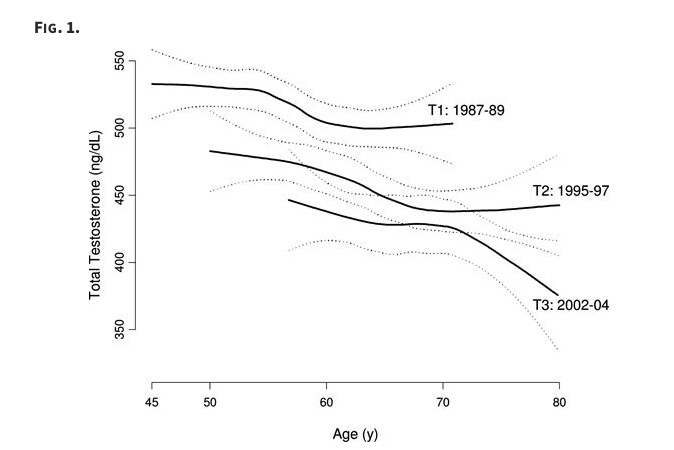
Therefore, it's possible that fatherhood-induced testosterone declines, which themselves may be exacerbated by modern family structures and male psychosocial dynamics, could nudge a father's testosterone levels from low-normal to clinically low.
Obviously, low testosterone drastically decreases the quality of life for the men who suffer from it. But low testosterone has deleterious effects that extend beyond the father.
Coming back to the inverted U, we established that excessively high testosterone levels are associated with lower child health scores, but nature takes care of that organically through fatherhood-induced testosterone declines. That's why they exist.
But what we haven't talked about yet is that excessively low testosterone is more detrimental to the health of a father's offspring than excessively high testosterone levels, because low testosterone leads to apathy, lethargy, and depressive tendencies, all of which reduce a father's efforts to protect, provide, and parent.
Unlike excessively high testosterone, nature does not have a solution for the unprecedented prevalence of low testosterone, because low testosterone is an artificial artifact of unhealthy living in the modern world.
This brings us full circle to land the central thesis of this article, which is that, when added to the general trends in declining testosterone levels, the tendency toward overinvestment in childcare exaggerates natural fatherhood-induced testosterone suppression to such an extent that it can culminate in clinically low testosterone levels, thereby reducing a man's ability to be a high-quality father.
The paradox is that the noble intention to be a good father backfires when it comes at the expense of a man's health and alignment with his masculine purpose — the two foremost characteristics that make a man a high quality father.
In Part 2 of this series, you're going to learn why it is your moral duty as a father to do everything in your power to avoid developing low testosterone, for the sake of your quality of life, your family's wellbeing, and for the continuation of our species as we know it.
Part 3 will arm you with a comprehensive series of evidence-based protocols that you can apply to your daily life to minimize testosterone decline as a father.
Be sure to subscribe to the newsletter so you don't miss them when they're published.
And if you want to shed the dad bod, sharpen your mental energy, and restore your sex drive without a lifelong TRT prescription, book a strategy call and I'll show you the exact framework I use to help career-driven dads reverse testosterone decline naturally.
I'll see you there.
References
- Boyette, A. H., Lew-Levy, S., Sarma, M. S., & Gettler, L. T. (2019). Testosterone, fathers as providers and caregivers, and child health: Evidence from fisher-farmers in the Republic of the Congo. Hormones and Behavior, 107, 35–45. https://doi.org/10.1016/j.yhbeh.2018.09.006
- Chasland, L. C., Yeap, B. B., Maiorana, A. J., Chan, Y. X., Maslen, B. A., Cooke, B. R., Dembo, L., Naylor, L. H., & Green, D. J. (2021). Testosterone and exercise: Effects on fitness, body composition, and strength in middle-to-older aged men with low-normal serum testosterone levels. American Journal of Physiology-Heart and Circulatory Physiology, 320(5), H1985–H1998. https://doi.org/10.1152/ajpheart.00010.2021
- Cheng, J. T., Kornienko, O., & Granger, D. A. (2018). Prestige in a large-scale social group predicts longitudinal changes in testosterone. Journal of Personality and Social Psychology, 114(6), 924–944. https://doi.org/10.1037/pspi0000126
- Gettler, L. T., McDade, T. W., Feranil, A. B., & Kuzawa, C. W. (2011). Longitudinal evidence that fatherhood decreases testosterone in human males. Proceedings of the National Academy of Sciences, 108(39), 16194–16199. https://doi.org/10.1073/pnas.1105403108
- Giannos, P., Prokopidis, K., Church, D. D., Kirk, B., Morgan, P. T., Lochlainn, M. N., Macpherson, H., Woods, D. R., & Ispoglou, T. (2023). Associations of bioavailable serum testosterone with cognitive function in older men: Results from the National Health and Nutrition Examination Survey. The Journals of Gerontology: Series A, 78(1), 151–157. https://doi.org/10.1093/gerona/glac162
- Grebe, N. M., Sarafin, R. E., Strenth, C. R., & Zilioli, S. (2019). Pair-bonding, fatherhood, and the role of testosterone: A meta-analytic review. Neuroscience and Biobehavioral Reviews, 98, 221–233. https://doi.org/10.1016/j.neubiorev.2019.01.010
- Meijer, W. M., van IJzendoorn, M. H., & Bakermans-Kranenburg, M. J. (2019). Challenging the challenge hypothesis on testosterone in fathers: Limited meta-analytic support. Psychoneuroendocrinology, 110, 104435. https://doi.org/10.1016/j.psyneuen.2019.104435
- Muller, M. N., Marlowe, F. W., Bugumba, R., & Ellison, P. T. (2009). Testosterone and paternal care in East African foragers and pastoralists. Proceedings of the Royal Society B: Biological Sciences, 276(1655), 347–354. https://doi.org/10.1098/rspb.2008.1028
- Ponce, O. J., Spencer-Bonilla, G., Alvarez-Villalobos, N., Serrano, V., Singh-Ospina, N., Rodriguez-Gutierrez, R., Salcido-Montenegro, A., Benkhadra, R., Prokop, L. J., Bhasin, S., & Brito, J. P. (2018). The efficacy and adverse events of testosterone replacement therapy in hypogonadal men: A systematic review and meta-analysis of randomized, placebo-controlled trials. The Journal of Clinical Endocrinology & Metabolism, 103(5), 1745–1754. https://doi.org/10.1210/jc.2018-00404
- Travison, T. G., Araujo, A. B., O'Donnell, A. B., Kupelian, V., & McKinlay, J. B. (2007). A population-level decline in serum testosterone levels in American men. The Journal of clinical endocrinology and metabolism, 92(1), 196–202. https://doi.org/10.1210/jc.2006-1375