The secret biological ingredient all great fathers have (according to science)

Men who are unaware that their hormones powerfully influence their ability to be effective fathers unknowingly possess a blind spot that can lead to worse outcomes for their children.
Hormones exert a direct and potent influence on the decisions we make, the actions we take, our physical health, and even the DNA of our children (10).
But before we dive deeper into the discussion about how your hormones affect your ability to be an effective father, we first need to define what that actually means.
I define being an effective father as behaving in ways that maximize the long-term health and wellbeing of your children.
There are four primary duties all fathers must fill in order to be effective:
- Procreating – you must be capable of producing viable offspring to be a father in the first place.
- Protecting – you must be capable of protecting your family from physical and psychological harm.
- Providing – you must be financially capable of providing a great quality of life for your family.
- Parenting – you must be capable of leading your family by being fully present and establishing values that will put your children in a position to mature into high-quality adults.
There is one hormone that reigns king in facilitating a man's ability to be an effective father, because it gives men fertility, vitality, energy, and motivation.
Unfortunately, average levels of this hormone are declining rapidly, and many of the behaviors society associates with being a "good" father reduce its production – paradoxically negating a father's ability to be effective.
That hormone is testosterone – the most controversial and misunderstood hormone of them all.
In this article, I'm going to explain how your testosterone levels affect your quality of life, your ability to be an effective father, and why it is your moral duty as a father to optimize your testosterone levels naturally.
What Most Men Get Wrong About Testosterone
There's one point I'd like to make clear before moving forward.
When I use the term "testosterone levels," I'll be using it interchangeably with concepts like "overall health" and "vitality," because research shows that a man's testosterone levels are an effective gauge of his overall health (15).
For this reason, optimal testosterone levels are the biological signature of a man who is thriving physically and mentally.

Just think: "low" testosterone = poor health, "high" testosterone = great health.
That said, if you take the "normal" reference range for testosterone levels at face value, you can be distracted by numerical values that don't matter all that much.
The specific numbers of what constitutes a "low" or "high" testosterone level varies drastically from man to man, so it's more practical to measure your testosterone levels by assessing how well testosterone is performing its functions in your body.
How do you determine that?
The best way is to subjectively rate how well you look, feel, and perform (physically, sexually, and cognitively).
- Are you reasonably muscular?
- Can you see any of your abs?
- How physically fit are you?
- How energized do you feel most days?
- Are you able to focus for a few hours?
- How self confident are you?
- How strong is your libido?
Your answers to questions like these will tell you more about how well testosterone is doing its job in your body than an arbitrary blood test.
And your answers to such questions are what you actually care about anyway.
It doesn't matter if your testosterone levels are 850 ng/dL if you have a dad bod and can hardly stay awake after 3pm.
The goal isn't to chase a higher number on a lab report. It's to optimize your physical and mental wellbeing to create the conditions for your body to maximize its natural testosterone production. For the reasons you'll learn next, doing so is your moral duty as a father.
If you're ready to stop guessing with lab numbers and start building a system that actually improves how you look, feel, and perform, book a call with me and I'll help you build one that fits your life.
Why Every Father Should Care About His Testosterone Levels
Your testosterone levels directly influence the health and wellbeing of your children from before they're even conceived, until the day they die.
That's not hyperbole. It's a scientific fact.
We'll start with how your testosterone levels influence the health of your children from the moment sperm meets egg.
P#1: Procreate
Your Testosterone Levels Affect the Health of Your Children Before They're Born
The first step to being an effective father is the ability to create viable offspring in the first place, and your testosterone levels are pivotal in your ability to do so.
One of the many functions of testosterone in male physiology is spermatogenesis, aka sperm production. For this reason, insufficient testosterone levels are a risk factor for male infertility (14).
Sperm counts, testosterone levels, and fertility rates are all on the downtrend at the societal level. The ability to reproduce naturally is quietly phasing out.
That said, all it takes is one sperm to fertilize an egg, so most men with low sperm count can still usually eke out a child.
But even if you can produce offspring with low sperm count, bringing them into the world could be doing them a disservice.
Poor sperm quality (which almost always goes hand in hand with low sperm count) is associated with a higher risk of multiple adverse health outcomes in offspring, including miscarriage, birth defects, cancers, psychiatric disorders, behavioral and social problems, etc (3).
Brand new research confirms that low testosterone is implicated in poor sperm quality (14).
Threading all of this together, low testosterone retards normal sperm production, which can result in lower sperm count and quality, leading to an increased risk of both infertility and adverse health outcomes in offspring.
And since your testosterone levels are a byproduct of your health status, the state of your overall health before your children are even conceived has a direct impact on their health in the future.
Your vitality, or lack thereof, will echo in your bloodline.
Research also shows that your testosterone levels directly influence your ability to be an effective father after your children are born.
Fathers With Higher Testosterone Have Healthier Kids
A 2019 study on fisher-farmers from the Republic of the Congo revealed an inverted U relationship between fathers' testosterone levels and the health of their children (1).
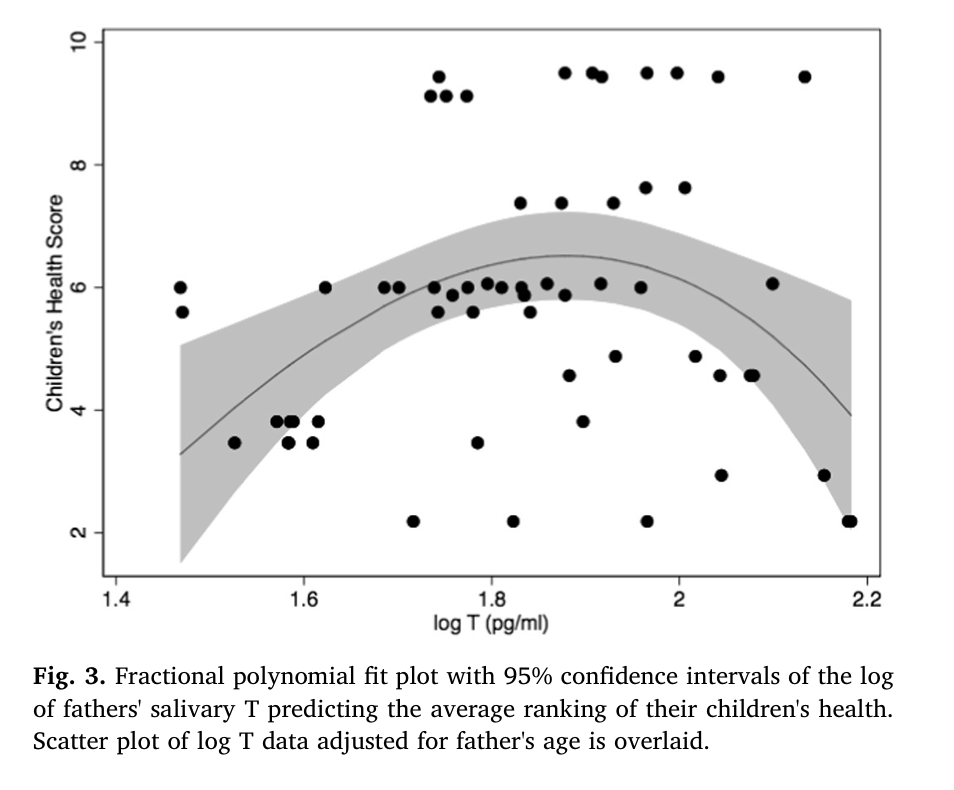
Fathers with very low or high testosterone levels had less healthy children than men with moderate to high testosterone levels (1).
The inverted U was slightly skewed towards higher testosterone levels, so the range of testosterone levels in fathers that corresponded to the healthiest children included moderate to high levels, but not extremely high levels (1).
Fathers with low testosterone had the least healthy offspring (1).
These findings beg the question: how do a father's testosterone levels affect the health of his children after they're born?
Unlike the effect of a man's testosterone levels on his sperm quality, which is physically passed on to his offspring, the effects of a man's testosterone levels on the health of his children after they're born comes about through his behavior.
Among the Congolese Fisher-Farmers (whose lifestyles closely resemble those of our premodern forefathers), a man's contribution to childcare was mostly indirect – through his ability to provide shelter, food, resources, and protect against predators and hostile tribes.
Fathers with low testosterone were more likely to exhibit depressive tendencies and lethargy, depriving them of the energy and motivation needed to adequately provision their offspring (1).
To the contrary, fathers with moderate to high testosterone levels had children with the highest health scores, and themselves had the highest "provider scores," a culturally derived metric wherein peers rank fathers according to how effective they are at providing for their families and the tribe as a whole (1).
The fact that fathers with higher testosterone levels were more effective at protecting and providing for their families makes complete sense when you consider the fact that testosterone drives:
- Physical performance.
- Muscle size and function.
- Red blood cell production and bone density.
- Energy and motivation.
- Protective instincts.
In sum, this study showed that fathers with moderate to high testosterone levels had the healthiest offspring because they were best equipped to protect and provide for their families, whereas fathers with low testosterone lacked the gusto to fulfill their indirect childcare duties, causing their children to suffer from hunger and disease, leading to poorer health scores.
That's great to know, but fathers in modernized civilizations don't have to hunt their own food, build their own shelter, or fend off wild animals.
So how are your testosterone levels relevant to your ability to be an effective father in the 21st century?
As it turns out, a man’s testosterone levels are still just as pertinent to his fathering efficacy as they've ever been.
P#2: Protect

If you think we're too "civilized" for violence in the modern world, you're mistaken.
I was too until I read Sam Harris' article about the shocking prevalence of violence in first-world countries.
If there's anything that's remained consistent throughout human history, it's violence.
You don't need to be a professional MMA fighter to fulfill your fatherly role as a protector of your family, but if you wouldn't stand a chance against a home invader, a child molester at the park, a crazed drug addict at the grocery store, or an abusive boyfriend in your daughter's bedroom, your children's safety is entirely at the mercy of statistics.
Although the chances are slim, when something as important as the safety of your children is at stake, I wouldn't bet on the odds.
It is far better to have the ability to physically defend your family and not need it, than to need it and not have it, and testosterone is a key hormonal mediator of this capacity.
Testosterone augments muscular function and development, giving you more muscle size and strength to subdue an aggressor.
Testosterone also biases men to respond to threats with aggression by increasing the likelihood that they choose to fight instead of flee in fight-or-flight situations (13).
Therefore, the difference between having low versus optimal testosterone levels could be the difference between choosing to fight in defense of your family or cowering and leaving them in danger.
There's also a phenomenon called "The Offspring Defense Paradox," which suggests that, although sensitive caregiving lowers testosterone levels in fathers, testosterone levels rise when fathers are provoked to protect their infant.
But if your baseline testosterone levels are low, this protective instinct won't be as potent.
Given testosterone's dual role in bolstering physical function and priming you to defend your family against threats with aggression, it is your moral responsibility as a father to ensure that your testosterone levels are optimized, so that you stand the best chance possible at protecting your family if it ever came down to it.
Imagine how regrettable it would be to not be able to stop a human trafficker from grabbing your two-year-old out of your wife's hands. I don't know about you, but I wouldn't be able to live with myself.
If that image hit you harder than you'd like to admit, book a free strategy call with me and I'll help you build a plan to make sure you're never the reason your family wasn't protected.
In addition to your ability to physically protect them, your ability to financially provide for your family is imperative for their long-term wellbeing, and, like your ability to protect, testosterone is the most powerful hormonal driver of your ability to provide.
P#3: Provide
Traditional Gender Roles Are Biological, Not Patriarchal
Throughout human history, gender roles have generally been arranged in such a way that men's contributions to child-rearing have largely been indirect: through protecting and providing, while women tend to hands-on aspects of childcare.
These traditional gender roles aren't merely societal constructs. They're domestic manifestations of differences in sex hormones that influence our traits and behaviors.
Men have 10-15 times higher testosterone levels than women, better equipping them for the physical, social, and cognitive demands of protecting and providing, whereas women have much higher oxytocin levels than men, predisposing them to nurturing and caregiving behaviors (12).
Contrary to popular belief, traditional gender roles aren't oppressive or discriminatory. They're consistent with the contributions men and women are best suited to make.
That's not to say that gender roles are completely black and white. To an extent, men help with direct childcare activities, and women contribute to provisioning and protecting efforts when needed (stay the hell away from a mama bear defending her cubs).
But in the modern world, the advent of the nuclear family has blended gender roles to an extent that is often detrimental to the health of family dynamics.
Fathers spend more time on hands-on childcare (which decreases testosterone) than ever before, and many women invest more into their careers than being mothers.
This inversion of traditional gender roles forces men and women into duties that are misaligned with what they're biologically designed for, leaving many couples unfulfilled as a result.
Evolutionary psychology wired men to be more purpose driven, and women to be more family-oriented, which is why, deep down, most masculine men would rather work than stay home changing diapers, and most feminine women would rather be mothers than employees.
And since parental dispositions rub off on children, the lack of fulfillment caused by this misalignment pervades the entire family unit.
Therefore, if you as a father can make enough money through work that you enjoy so that your wife doesn't have to work out of necessity, you can free her to focus all of her time and energy entirely on being a mother, which will ultimately leave both of you more fulfilled and create a happier family overall.
Not only that, but financially freeing your woman to be a full-time mom ensures that your children receive the unconditional love and care they need to develop in a healthy way.
Research shows that lack of attention and unconditional love during childhood leads to insecure attachment styles and mental health problems later in life (9).
That's why it is your moral duty as a father to at least have the ability to financially provide the opportunity for your woman to fully commit herself to motherhood if she so chooses.
That's a much better position to be in than your woman secretly resenting the fact that she has to work at the expense of dedicating herself to being a mother.
How Your Paycheck Becomes Your Kids' Health

What's more, research shows a connection between lower income and a higher risk of death from poor health (16).
There are many reasons for this, but I'll use the example of food quality to articulate how low income negatively affects a family's health outcomes.
Before even having kids, if you and your wife had to live off cheap, low-quality food because you couldn't afford higher-quality healthy food, the negative health effects your pre-parental diet had on your own health will be passed on to your children (10).
For example, children of diabetic parents have a higher risk of developing diabetes themselves (6).
After your kids are born, if you have to feed them cheap, low-quality food because you can't afford higher-quality healthy food, that will directly damage their health.
This is the modern equivalent of a hunter-gatherer whose kids starve because he couldn't successfully "bring home the bacon."
If a modern man can't make enough money to feed his entire family healthy food, they "starve" from metabolic disorders, obesity, and chronic disease caused by the lack of nutrients and toxic artificial ingredients in low-quality food.
Higher income neighborhoods are also less violent and have fewer health-harming environmental toxins and pollutants.
The adverse effects of low socioeconomic status aren't just limited to physical health.
In his book Behave, Robert Sapolsky wrote about research showing that lower socioeconomic status restricts the fullest expression of a child's genetically determined cognitive abilities.
In other words, poverty blunts the realization of a child's fullest intellectual potential.
The overarching point is that your ability to financially provide a great quality of life for your family directly impacts their health and wellbeing.
And your testosterone levels are the leading hormonal driver of your ability to do that. Here's how.
Testosterone Boosts Your Earning Potential
In the past, testosterone has facilitated a father's ability to provide through his physical prowess. Our forefathers needed physical strength to hunt and forage to put food on the table.
In the modern world, men work to earn a paycheck, and use that money to put food on the table. The end result is the same. Only the means have changed.
But unless you're a professional athlete, most men in the modern world are knowledge workers who earn their living using their brains. Even jobs that require manual labor, like tradesmen, farmers, landscapers, and construction workers all use tools and modern technology.
We no longer need physical prowess to provide for our children like our predecessors did (or how modern-day subsistence populations like the Congolese Fisher-farmers still do).
Nonetheless, your testosterone levels are just as important for your ability to provide for your family as ever before, as evidenced by research showing a positive relationship between a man's testosterone levels and his socioeconomic status (5).
There are several causes underlying this correlation. Some are cosmetic, others are behavioral.
Conventionally attractive individuals experience a "beauty premium," earning roughly 5% to 10% more than their less attractive peers (4).
Testosterone contributes to male attractiveness by increasing a shoulder to waist ratio and promoting the development of masculine facial features (11).
Testosterone also enhances mental energy levels, memory, focus, and cognitive performance, thereby increasing a man's productivity in knowledge work tasks.
Lastly, testosterone biases men toward status-seeking, risk-taking, and dominant behaviors, which can provide a competitive edge in the workplace.
By making you more attractive, productive, and competitive, having higher testosterone levels gives you a biological advantage that increases your earning potential – the central determinant of your ability to financially provide a great quality of life for your family.
Yet another reason why it is your moral duty as a father to optimize your testosterone levels naturally. But not the last one.
P#4: Parent
Why Dads With Low Testosterone Run Out of Patience First
One of the most important aspects of good parenting is being present, which involves giving your kids your undivided attention. Simple, but not easy.
Keeping up with your kids requires a lot of energy – something that testosterone gives you.
If you lack the energy to read your kids a story after 8pm or play ball with them at the park on the weekends because your testosterone levels are low, you're doing them a disservice.
Kids also require a lot of patience.
Testosterone is involved in emotional regulation, and low testosterone is associated with irritability and mood swings (7).
In his book Behave, Robert Sapolsky also talks about how many species of mammals (especially humans) have a distasteful tendency to abuse weaker individuals of the same species when they're highly stressed.
"Misery loves company" isn't merely a colloquialism. It's an established biological phenomenon.
The connection to testosterone is that high levels of the stress hormone cortisol suppress the hypothalamic-pituitary-gonadal (HPG) axis: the signaling pathway that regulates testosterone production.
Simply: stress disrupts the signal that tells your body to make testosterone (which, as we’ve said, helps you regulate your mood).
Given this evidence, I’m willing to say that low testosterone due to unmanaged stress could increase your susceptibility to abusive behavior.

Crucially, not all abuse is physical, or even conscious.
If you're perennially in a foul mood and you let it out on your kids through demeaning remarks or a negative disposition, you could be doing serious psychological harm to them.
If you’re squirming because that sounds like something you’re guilty of, book a strategy call with me and I’ll help you re-calibrate the biological foundation that’s making you miserable.
Since your hormones are responsible for your energy levels and emotional regulation, both of which directly influence how you show up for your family, ensuring that your hormonal profile is optimized is your moral duty as a father.
Optimizing Your Testosterone Levels is Your Moral Duty as a Father
The central thesis of this article is that it is your moral duty as a father to optimize your testosterone levels because they directly contribute to your ability to fulfill the 4 P's of effective fathers:
- Procreate: testosterone drives sperm production and quality.
- Protect: testosterone augments physical capacity and protective instincts.
- Provide: testosterone increases earning potential.
- Parent: testosterone supports energy levels and emotional regulation.
When consistently and effectively fulfilled, the 4 P's maximize the long-term health and wellbeing of your children – the ultimate outcome effective fathers strive for.
The conundrum we haven't talked about yet is the fact that many of the behaviors society tells men make them "good" fathers actually decrease testosterone levels, paradoxically making them worse fathers.
In next week's newsletter, I'm going to show you how you can avoid them and preserve your testosterone levels after becoming a father. If that sounds interesting, feel free to subscribe to the newsletter so you don't miss it.
Because when you stack fatherhood-induced testosterone declines on top of the fact that testosterone levels are declining at the societal level, many fathers end up with dangerously low testosterone, which negatively affects their quality of life and the wellbeing of their children – who will make up the next generation responsible for the continuation of humanity.
As Maximus from Gladiator famously said: "What we do in life echoes in eternity."
Your vitality as a father echoes in your bloodline, society at large, and the future of humanity.
Don't treat it as an afterthought.
If you're ready to make sure your vitality is an asset to your family instead of a liability, book a strategy call with me and I'll help you map out a plan built around your specific situation.
Cheers,
Josh
References
- Boyette, A. H., Lew-Levy, S., Sarma, M. S., & Gettler, L. T. (2019). Testosterone, fathers as providers and caregivers, and child health: Evidence from fisher-farmers in the Republic of the Congo. Hormones and Behavior, 107, 35–45. https://doi.org/10.1016/j.yhbeh.2018.09.006
- da Silva Rodrigues, G., da Silva Sobrinho, A. C., Pinto, A. P., Lione, R., de Sousa Neto, I. V., & da Silva, A. S. R. (2026). Paternal preconception exercise and sperm epigenetic mechanisms: A systematic review on offspring health. Epigenomics, 18(2), 217–229. https://doi.org/10.1080/17501911.2026.2620390
- Halvaei, I., Litzky, J., & Esfandiari, N. (2020). Advanced paternal age: Effects on sperm parameters, assisted reproduction outcomes and offspring health. Reproductive Biology and Endocrinology, 18(1), 110. https://doi.org/10.1186/s12958-020-00668-y
- Hamermesh, D. S., & Biddle, J. E. (1994). Beauty and the labor market. American Economic Review, 84(5), 1174–1194. https://www.nber.org/papers/w4518
- Harrison, S., Davies, N. M., Howe, L. D., & Hughes, A. (2021). Testosterone and socioeconomic position: Mendelian randomization in 306,248 men and women in UK Biobank. Science Advances, 7(31), eabf8257. https://doi.org/10.1126/sciadv.abf8257
- InterAct Consortium. (2013). The link between family history and risk of type 2 diabetes is not explained by anthropometric, lifestyle or genetic risk factors: The EPIC-InterAct study. Diabetologia, 56(1), 60–69. https://doi.org/10.1007/s00125-012-2715-x
- Johnson, J. M., Nachtigall, L. B., & Stern, T. A. (2013). The effect of testosterone levels on mood in men: A review. Psychosomatics, 54(6), 509–514. https://doi.org/10.1016/j.psym.2013.06.018
- Meijer, W. M., van IJzendoorn, M. H., & Bakermans-Kranenburg, M. J. (2019). Challenging the challenge hypothesis on testosterone in fathers: Limited meta-analytic support. Psychoneuroendocrinology, 110, 104435. https://doi.org/10.1016/j.psyneuen.2019.104435
- Norman, R. E., Byambaa, M., De, R., Butchart, A., Scott, J., & Vos, T. (2012). The long-term health consequences of child physical abuse, emotional abuse, and neglect: A systematic review and meta-analysis. PLOS Medicine, 9(11), e1001349. https://doi.org/10.1371/journal.pmed.1001349
- Pastore, A., Badolati, N., Manfrevola, F., Sagliocchi, S., Laurenzi, V., Musto, G., Porreca, V., Murolo, M., Chioccarelli, T., Ciampaglia, R., Vellecco, V., Bucci, M., Dentice, M., Cobellis, G., & Stornaiuolo, M. (2024). Pre-conceptional paternal diet impacts on offspring testosterone homoeostasis via epigenetic modulation of cyp19a1/aromatase activity. npj Metabolic Health and Disease, 2(1), 8. https://doi.org/10.1038/s44324-024-00011-8
- Penton-Voak, I. S., & Chen, J. Y. (2004). High salivary testosterone is linked to masculine male facial appearance in humans. Evolution and Human Behavior, 25(4), 229–241. https://doi.org/10.1016/j.evolhumbehav.2004.04.003
- Rajhans, P., Goin-Kochel, R. P., Strathearn, L., & Kim, S. (2019). It takes two! Exploring sex differences in parenting neurobiology and behaviour. Journal of Neuroendocrinology, 31(9), e12721. https://doi.org/10.1111/jne.12721
- Sapolsky, R. M. (2017). Behave: The biology of humans at our best and worst. Penguin Press. https://www.penguinrandomhouse.com/books/542188/behave-by-robert-m-sapolsky/
- Serbouti, A., Berrada, K., Housbane, S., Louanjli, N., & Aboutaieb, R. (2026). Low testosterone and sperm quality alterations: A prospective study of sperm DNA fragmentation and chromatin condensation in infertile men. Biology, 15(3), 287. https://doi.org/10.3390/biology15030287
- Yeap, B. B. (2013). Hormones and health outcomes in aging men. Experimental Gerontology, 48(7), 677–681. https://doi.org/10.1016/j.exger.2012.07.012
- Liu, L., Wen, W., Shrubsole, M. J., Lipworth, L. E., Mumma, M. T., Ackerly, B. A., Shu, X. O., Blot, W. J., & Zheng, W. (2024). Impacts of Poverty and Lifestyles on Mortality: A Cohort Study in Predominantly Low-Income Americans. American journal of preventive medicine, 67(1), 15–23. https://doi.org/10.1016/j.amepre.2024.02.015